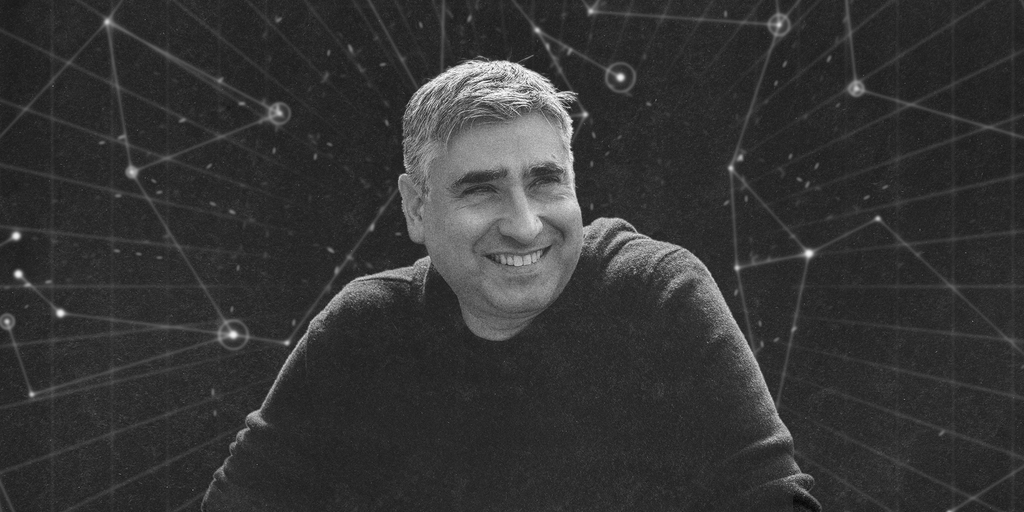
In the last few months, three companies backed by Martin Casado have sold for a combined $76 billion, some of the largest deals in venture history. A general partner at Andreessen Horowitz, he leads the infrastructure practice, a wide remit which includes the Infrastructure I ($1.25B), Infrastructure II ($1.7B), and Machine Age ($1.1B) funds. This year, SpaceX acquired the AI coding company Cursor for $60 billion, the largest-ever acquisition of a venture-backed startup. Stripe has bought the model routing platform OpenRouter for $8 billion, and this week, AMD completed its acquisition of Fei-Fei Li’s World Labs, which builds spatial intelligence AI that perceives and interacts with 3D and 4D environments, for $8.2 billion. Casado has sat on the boards of Cursor and World Labs and co-led a16z’s investment in OpenRouter.
Born in Spain, Casado grew up in a succession of small towns across the American West. He began his career at Lawrence Livermore National Laboratory, doing computational physics. After completing a PhD at Stanford, he founded Nicira, which pioneered software-defined networking, in 2007. When Nicira struggled through the Great Recession, Marc Andreessen and Ben Horowitz backed it decisively; the startup was acquired by VMware for $1.26 billion in 2012, becoming the first company to return an entire a16z fund. He led VMware’s networking and security business before joining a16z in 2016.
Casado calls himself a “productive investor,” betting that disruptive technologies will create new markets rather than carve up existing ones. As Anthropic began trading Thursday morning, valued at $1.5 trillion, the era of the small-cap tech IPO seems to be over. I sat down with him this week to discuss the evolution of a16z, his investments in Cursor and other AI companies, and how the growth of private markets has fundamentally changed who captures tech’s biggest gains. What follows is a transcript of our conversation.
CB: You basically grew up in a European family dropped into rural America. What was that experience like?
MC: My dad was in the hotel industry. He was Spanish, born during the Spanish Civil War, so he probably had a seventh-grade education. As the story goes, he met my mom in Tahiti on a cruise ship that he was a purser on. I’m just going to assume it’s true. She’s Italian American, and she moved to Spain for him. She hated Spain, and all he knew was working in hotels. But he worked in very nice hotels. He was general manager. Then we moved to the United States, and he kept getting jobs at the nicest hotel in some really small western city. We were always that odd European family associated with the nice hotel in a rural American city. But honestly, the most important thing is I saw him start as a front desk clerk, become a general manager, get a Ph.D., become a very well-respected professor in hotel and restaurant management, and then write a bunch of books. Listen, I grew up a Western American Nintendo-generation geek, like a lot of people, and there was nothing particularly extraordinary about that, other than we were poor. But I did get to see my father, who didn’t have many opportunities, go and become a professor, and that was pretty fucking awesome.
CB: I read that you did nuclear simulations at Lawrence Livermore after college. How would you compare the conceptual problem of simulating something with forecasting something, which I guess is part of what you do now as an investor?
MC: Interesting. So I was doing physics, then I switched to computer science basically midway through college. I thought I liked physics, but I found most of the interesting problems were about using computers to solve them, and I just got enamored with computers. So my first job was computational physics, doing the computer work for the simulations. I don’t think I forecast things in this job. Some investors do, the public market types: what is the market doing? I’m a very different type of investor than that. But I will say that time was very, very formative. There are a lot of analogs to the current AI moment. We were so worried that Saddam Hussein would use CPUs for weapons that we put export controls on the PlayStation. We weren’t allowed to sell supercomputers to China. We were using these supercomputers that only the government could buy to simulate nuclear weapons, and there was a lot of concern about this stuff having massive security implications. There was also the concern that only a few places could afford a computer that big, and because of that you’d get monopolies. And by the way, all of this was happening while the internet was starting, so there was all the fear about cybersecurity. I think people just forgot. At the time, things felt just as existential and just as uncertain as they do today with AI. It really was the same feeling, except tech was so much smaller as an industry. People didn’t fear the broader tech footprint the way they do today, because now it’s so huge. We went through social media and so on. I actually think a lot of the way I think about the world came from that experience.
CB: Did you get a sense of the infamous inter-lab rivalry? Lawrence Livermore versus Los Alamos?
MC: What did we say? “Russia is the competition, but Los Alamos is the enemy.” Seriously, yeah. There’s actually a phenomenal book called Nuclear Rites, R-I-T-E-S. It’s an ethnography. An anthropologist sat in the cafeteria at Livermore and wrote about the intellectual and mental models of the weapons designers, and I would say that book gets it right. It does a really good job of capturing what it meant to be a “labbie” working in the weapons program.
CB: I’m gonna have to check that out.
MC: I don’t even know if it’s in print anymore. It’s a very obscure book, but there’s just not a lot written about the people who actually work on weapons, and it’s one of the few that really gets what it felt like to be in there. I was in the weapons program. I was in A Division, which focuses on thermonuclear weapons physics.
CB: Tell me a little bit about Nicira, where you were CTO and co-founder?
MC: I was at the labs, then 9/11 happened. I moved to cybersecurity. I started taking courses because I didn’t know much about it. I got into the Ph.D. program at Stanford, did that work, and I was going to be faculty at Cornell. I decided to take a year off and start a company, Nicira, which was basically my Ph.D. research. I took the team with me and we started it. I had two co-founders, Nick McKeown and Scott Schenker, but they were both professors, so I was the primary founder. I had the most ownership. I was the only one who was really there full-time. This was 2007 when we started, and we were trying to change networking and turn it into a software problem instead of a hardware problem.
And then 2008 happened, and that was the end of the world, the Great Recession. So the first three years were a story of meager survival. By the way, it was a fucking dismal time. The world was coming to an end. Sequoia had just released this slide deck called “R.I.P. Good Times,” and the first slide was literally a gravestone that said “Rest in peace, good times.” It was basically: it’ll never be the same, fire everybody. The whole thing was so dismal. And I’m sitting there struggling. I can’t raise. I’ve got 12 people I convinced to join me. The world is ending. I just turned down an Ivy League professorship because I couldn’t leave my team, and all the VCs are saying, “You guys are all fucked.” And then Marc wrote “Why Software Is Eating the World,” and it was this full-throated, optimistic, tech-is-positive, it’s-going-to-be-great piece. That was such a turning point for me because it gave everybody their mojo back. We raised our Series A from them. Ben joined the board. We were their first fund returner. We went from one of their first Series As to a billion-dollar exit. But again, a lot of the formative stuff is that you’re at the bottom of the Great Recession, the VCs are saying it’s over, fire all your people, and then you actually have people who are tech-positive. It’s just such an amazing thing.
CB: When you got onboarded at a16z, I’m curious, was there any kind of… There’s the classic Peter Thiel contrarian interview question — “What important truth do very few people agree with you on?” Is there a Ben and Marc variation of that?
MC: These guys knew me so well. They invested in me before the firm existed. And by the way, they’d seen every terrible side of me. Being a founder is being in a pressure cooker, man. It is tough, and they just knew it. Ben was on my board. In the early LP days, they’d trot out entrepreneurs, and I was one of the founders they trotted out: “Here’s our infrastructure portfolio.” So yes, I talked to all the GPs and the operating partners, but it was much more about whether this was the right thing for both sides than a formal interview, because I was such a known quantity back in those days.
CB: Back then you had to be a founder to be an a16z partner, right? And I think that’s changed. Jennifer Li came up from the analyst ranks, right? So that’s changed over the last decade or so?
MC: When I joined, the rule was you had to be a founder: CEO or CTO, but a founder. Most of us had a big exit or had been founders at scale, but not everybody. There were a couple of small exceptions, but that was the rule.
And there was no internal promotion path. That was a very explicit rule. I think the first time we changed that was with Connie Chan, and then Jennifer Li. It was a totally different vibe, too. You had a bunch of alpha CEOs who wouldn’t listen to each other around the table. I used to have something like 12,000 people, with 4,000 people overlaid on me, a $600 million business. I just wasn’t used to taking orders, and you had all of those people in a room.
It was a very crazy dynamic. Then we learned a couple of things. One is that we do venture in such a unique way that it’s very hard to take people from outside the firm. We’re very structured in how we think and how we approach it. We have done it successfully — Chris Dixon of course came from outside the firm, and a few others — but for the most part it hasn’t been super successful. And we found that we’re very good at training people. So these days the promotion path is primarily internal.
CB: When you hire, do investment bankers make good recruits for venture? What skill sets are you filtering for that really work?
MC: I think there are many types of investing, and you just have to be consistent with your type. You’ve probably seen me write about it in [blog posts](https://a16z.com/the-evolving-landscape-of-venture-capital-mindsets/). Bankers are good financial investors, and financial investors should invest in companies you can reduce to the balance sheet or the operating plan. If the business metrics are a good enough representation of the company and the market, a banking background is great.
Some people are purely speculative: the market is down, I’m smarter than the market, and they don’t even really care what the asset is. They just know the market is going to shift. Other people are frontier investors, like Chris Dixon, which is just fucking YOLO, man. A talented founder in a new space, maybe it works. That’s the original form of venture: investing in people in crazy, new, daring spaces. But I don’t do any of those.
What I do I call productive investing: investing in an asset before the market has figured it out, but an asset you can actually evaluate. You can evaluate the team, the technology, and its approach to the market. For that, a banking background doesn’t help, because if you haven’t been piped into the nervous system where tech meets product meets market, you don’t even know how to diligence it.
And you can’t rely on the business metrics, because they always lag disruptive tech. If you say you invest in disruptive tech, you’d have to wait until it’s actually disrupting something to determine that with metrics. You can’t use market size; you can’t use metrics for the evaluation. Now, I don’t want to dismiss any investment path, because they’re all very legitimate, and there are great investors who do all of these. But for the type of investing I do, no, banking is not the right background.
CB: How do you look at infrastructure? How do you define its parameters as an investor?
MC: Infrastructure, yeah. I’ve got three quippy ways to describe it. One, infrastructure is the stuff used to build apps. Two, there’s a technical buyer. And three, for us, it’s all computer science software infrastructure. That’s it: compute, network, storage, databases, foundation models, dev tools, security. Technical buyer, the stuff used to build or run the stuff, software. That’s my remit. Which, by the way, is something like a $3 trillion market. It’s an effectively infinite market.
CB: Looking at your board seats, I couldn’t help but wonder what your week looks like. It seems like you’ve got a lot on your plate. How do you manage that, and prioritize your time?
MC: After running a global business that hit a billion dollars the year I left, being a VC and sitting on a few boards is nothing compared to that workload. Absolutely nothing. I’ll give you my rough day. I wake up around 7:30. I do email for half an hour to an hour, then board meetings or pitch meetings until around six. Then I spend two hours with the family. They go to sleep and I go back to work for three or four hours, and I work most weekends. That’s it.
When I was joining VC, the cliché was that VCs wouldn’t work Fridays, certainly not weekends. They’d take long holidays. They wouldn’t work evenings. But things have changed so much. My team works so fucking hard. And it’s not a hustle-culture thing I’m imposing on them. The industry has adopted an attitude very similar to founders’, and people really put in the time. You’re not as busy as a founder, for sure; founders are much busier and work much harder. But if you’re on a similar cadence, having a few board seats is not that much.
CB: But you can’t have hobbies, right, if you’re working that much? I’m joking. I was looking at your X feed, and you have a bit of a music hobby, which is kind of cool.
MC: If you’re ever out here, I need to take you to my house. I’ve got a big office, and when you walk in, it looks like the set of a 1970s sci-fi movie. I’ve got so much retro analog gear, it’s unbelievable. I’m a classically trained pianist. I played piano most of my life, but then I stopped, and now I suck. But I remember what it feels like to be good, so it’s frustrating, and I don’t play because of that. But I love music, and the great thing about analog gear is there’s no right or wrong. You’re literally just tweaking knobs and patching wires to make weird sounds. I like making these soundscape-y things for fun.
CB: That’s great. So I want to talk about Cursor with you. Obviously that’s the big one. I really look at Anthropic as the model company, and I’m curious what kind of future you think Cursor and SpaceX have in store. Is SpaceX ever going to become the model company? Do you think it’ll go more the route of a merger with Tesla? What’s going to happen there, if you had to guess?
MC: I think these markets are so large that there’s just tons of room for multiple players. Tons. You have winners in the speech space, like ElevenLabs. You have winners in the 2D image space, like Ideogram and BFL, winners in the music space, like Suno. People use OpenAI very differently than Anthropic. ChatGPT is more of a consumer product, similar to Google, whereas Anthropic is more enterprise-focused. And if you think about the assets, one thing SpaceX does a tremendous job of is Grokbot. It’s absolutely my favorite thing. I use it all the time. People use it all the time. I think they absolutely nailed that. Once you have that data and that presence, you can 100% build models that are useful. And Grokbot doesn’t use one model; it can use multiple models. So I’d refrain from any zero-sum thinking in this space, because things grow so quickly. Anthropic is a phenomenal company. They make phenomenal models. They’ll continue to be tremendously relevant. But SpaceX has tremendous data, a tremendous team, tremendous amounts of compute, plus a phenomenal product that people use, and they build good models. So I think these will all be players.
CB: It seems to me something has changed a lot in the private markets. If you look at where Amazon went public at $438 million, or where Nvidia went public at $343 million, the retail investor had an opportunity to ride that growth in a way they’re never going to have with Anthropic. They didn’t have it with SpaceX. I almost see this as a slight breakdown in the social contract. The American public getting in on these companies, pre-growth, was a thing at one point. What are your thoughts?
MC: No, this is a great line of inquiry. I wish people would spend more time on it. There’s so much to write about here. You’re 100% correct. So why doesn’t retail have access to private markets? Because somebody deemed them too risky for individuals. That’s why. It wasn’t the private markets; private markets welcome anybody. They’re a market. It was a government and regulation thing. And the reality is, if there’s liquidity in private markets, why go under the scrutiny of the public markets if you don’t have to? At some level you’re trying to balance protecting consumer investors against access to growth. Somebody should write the strong form of this: did we get it right? Should we rethink this? I actually don’t have a firm opinion; I can see both sides. But your observation is very important and critically underdiscussed.
People used to say the mega-funds can’t return anything. Trust me, the private markets are now so large you can’t over-invest in them. The returns are phenomenal. They’re going to be record-breaking. My returns alone are record-breaking, and we invest out of large funds. Private markets have an infinite capacity to absorb capital and return it, and it’s a great discussion to what extent this should be open to everybody. I’m glad you picked up on it, because I just don’t think a lot of people have. It’s one of the most important dynamics in the United States right now, and it’s underdiscussed.
CB: Yeah, you don’t hear it talked about much. What do you think would make it easier to get to the public markets?
MC: No, it’s not that. It’s not about the public markets. Unless you’re an accredited investor, you can’t really invest in private markets. That’s it. That’s the issue. And that’s a public rule. That’s the law. So this is a retail investor protection. But to your point, it’s worth revisiting: is this actually the right thing? Maybe people can take care of themselves. Maybe it’s fine for somebody to take risky investments and lose money, or maybe not. You can come out on either side, but that’s the discussion to have. Some people try to frame it otherwise, but companies would be very happy to take more money. That’s not the issue. It’s that people just aren’t allowed to.
CB: How many deals have you worked on over your career?
MC: Quite a few. I think I'm approaching 300 deals.
CB: Approaching 300. Well, let’s compare two of them.
MC: I have a few more minutes. Go ahead.
CB: How would you compare the TypeSafe and Cursor deals?
MC: In both cases you have brilliant founding teams that created a phenomenon, some of the fastest-growing things we’ve ever seen, rooted in a deep technical foundation and philosophy that you can see playing out in real time. Now, we invested in Cursor at $4.5 million ARR, and it was more of a product company at the time, less of a model company. In fact, after we invested, it moved from an IDE to an agent runner to a model company. It had to disrupt itself three times.
TypeSafe is a model company; they do decision models. The numbers aren’t public, but they’ve been leaked, and the company is growing very asymptotically. So it’s a bit different, in that one’s a model company and the other is a product company. But they were both these lightning-in-a-bottle phenomena, with absolutely phenomenal, brilliant founders.
CB: What did Cursor’s founders do that made you write the check at $4.5 million ARR?
MC: As with every deal, we do a lot of work and try to answer whether the company is the winner in the space. At the time we looked, the growth was asymptotic. The team had by far the sharpest vision of both what developers needed now and where things were going. And the product was simply magical. We all used it\!
CB: As Cursor disrupted itself, which of those shifts was most nerve-wracking for you as an investor? Did you ever push back on it?
MC: You know, every quarter there was some major competition. Even when we made the investment, many asked how Cursor could compete with Microsoft’s GitHub Copilot. Then of course there was a moment with Windsurf, as a serious competitor. And then Cognition. And then Claude Code. And Codex. And the ever-improving models. All this in the space of a few years. I think the pace of AI is just furious, and reinventing yourself is the norm. At this point I just expect it. But I will say the team managed it far more deftly than I expected them to. Just world-class execution.
CB: I saw there was some news with World Labs this week. AMD completed the acquisition, $8.2 billion.
MC: Yeah, you know, Fei-Fei Li, the founder, texted me 10 minutes before we started this call: “They’re not letting me into the building at the San Francisco office.” So I had to go down and rescue Fei-Fei from the rainy street because they wouldn’t let her in. She’s inside now. But she’s awesome. She’s amazing.
CB: Of the founders you’ve worked with recently, is there anyone who stands out as a particularly unique or unprecedented personality? Anyone who introduced you to something new? I’m sure it gets harder when you’ve been in the game so long.
MC: Listen, they’re all so great. I’ll tell you something kind of funny. Most people, when they talk about loving VC, say, “Oh, I love working with founders.” But here’s what I’ve learned: founders are like me. I was a founder, and founders don’t like to listen to people. They like to do things their own way. It’s great being a partner with them, but you’re not going to tell them what to do.
On the other hand, my team and I are so tight. We have to make decisions together in a very enclosed way, and there’s a lot of fate sharing. So I love working with founders, but really as somebody in the room, because they’re doing their own thing, and unless you’re inside the company, you can only get so close. With my team, we’re thick as thieves, because we do all this stuff together. I feel very lucky to have both.
But I can’t pull out an individual founder. They’re all so great and unique, and it’s so fucking hard to do what they’re doing, man. I don’t think people understand the trauma the average founder is going through. It’s a total pressure cooker. I have so much respect.
CB: Well, I’m sure it’s tough to choose. But I can't help but notice how frequently Ion Stoica keeps coming up in conversations on AI infrastructure. What is it about him and his Sky Computing Lab that makes it so prolific?
MC: I did research with Ion Stoica back in 2003. I’ve known the guy for over 20 years. When I was a Ph.D. student, I worked on a project with him called the 100x100 Clean Slate Internet Project, with Carnegie Mellon. And my co-founder was Scott Shenker, who works with him at Berkeley. So I’ve known Ion for a long time.
Listen, the guy’s one of the best systems thinkers on the planet. He’s one of the hardest workers on the planet. He’s very pragmatic. He’s a really special guy. What he has done, which a lot of Stanford professors have not, is… a lot of Stanford professors are dilettantes. They’ll spin something up, be kind of involved, then go do something else. They’ll have five things going at once. They flutter in and flutter out. Ion grinded it out as fucking CEO of Databricks. He’s very much on the ground helping out, not just being the smart dilettante in the room. He’s really done it right. It’s very easy as a superstar professor to attach your name, sit on a few boards, say some random aphorisms, and think you’re helping. That’s so common. But he’s not that guy. He’s very special.
CB: You have watched venture change quite a bit since you joined a16z in 2016. Where is it headed?
MC: I’ll just say one thing. When Silicon Valley venture was created in the ’70s, it was a thousandth of the size it is now, and it was almost a historical quirk: you’d create a venture firm the way you’d create a law firm. A bunch of loose partners doing whatever they wanted. They shared a building, but that’s about all they really shared. Maybe there was an IC, but whatever. When I joined the firm in 2016, the cracks in that model were clearly showing, and the firm said, “Listen, these guys don’t show up, they don’t know anything, whatever. We’re going to build this operating platform.” I think that’s been phenomenal for the last 10 years.
But we’re going through another renaissance now. The market has grown another 10 to 100 times. It’s a massive market. AI is disrupting a lot of stuff, and it turns out you can deploy effectively infinite capital in private markets, because they’re now large enough to replace IPOs. So we’re rethinking venture again. How do you scale it? Do you verticalize? What does that mean for founders? A lot of my career over the last 10 years has been figuring out this new modality.
A lot of what you and I are talking about is the rumination you go through to move from the previous model, which was about fixing a broken model, to scaling it to the level of the largest banks. I think we’re well on our way as an industry, not just a16z, to doing that. And it changes who the investors are, how they think, how they engage with companies. It changes everything.
This interview has been edited for grammar, length, and clarity