|
New on Substack: Creator match, audience-specific content blocks, global reply rules, advanced podcast transcript editing, and more
Reach new subscribers, deepen relationships with the ones you have, and build a more sustainable business around your work
| ||||||||||||


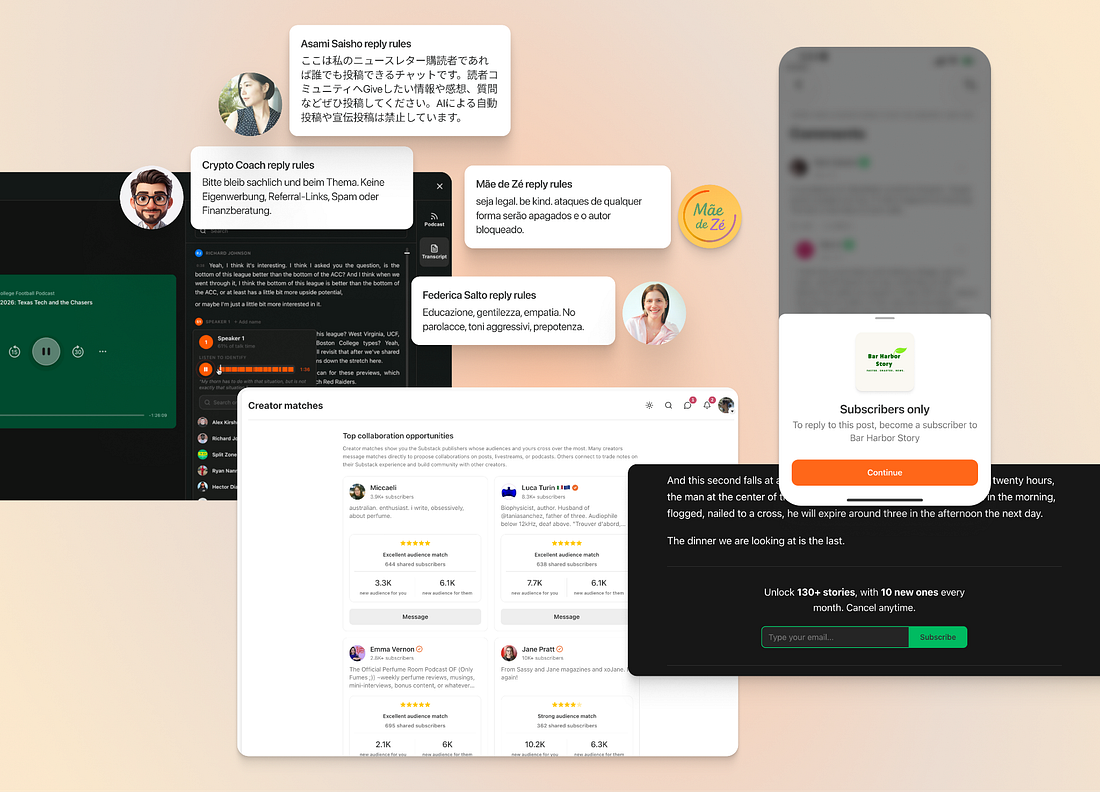 |
We know that finding the right audience and then giving them compelling reasons to continue to support your work is core to being successful on Substack. The features we launched this month allow you to do both these things: reach new subscribers and create richer experiences for your existing ones. Here’s the latest.
Creator match
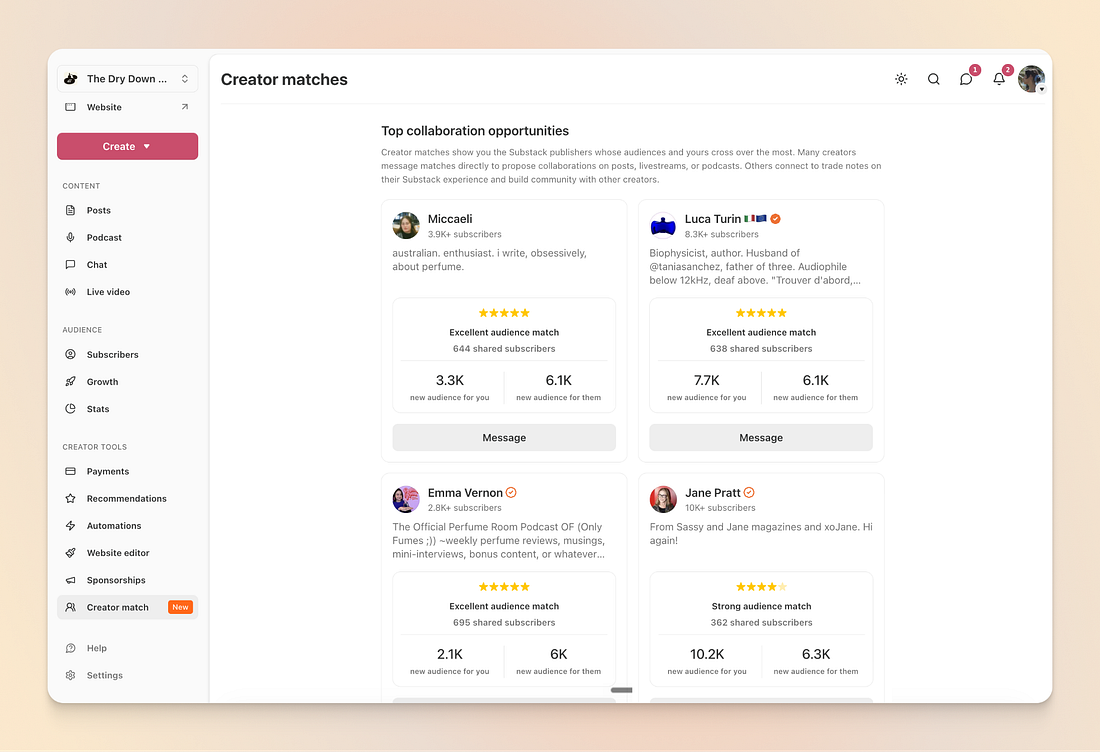 |
Starting today, all publishers have access to creator match, a new feature that helps you easily find relevant collaborations with other publishers. Creator match identifies writers and creators with similar audience sizes and interests, then curates them for you, ranked by how promising the collaboration could be for both of you. You can find the feature in your publisher dashboard.
Collaborating with other Substack publishers is one of the most powerful routes to grow on the platform, and it’s how many Bestsellers got their start. Lenny Rachitsky of Lenny’s Newsletter and Elena Verna of Elena’s Growth Scoop; Packy McCormick of Not Boring and Noah Smith of Noahpinion have collaborated via cross-posts, recommendations, and podcast episodes, or shared each other’s work in a Note. These collaborations put your work in front of like-minded audiences and give new readers a reason to subscribe: they’re discovering you via a publisher they already trust.
You can message fellow publishers directly from the creator match dashboard to initiate a collaboration.
Segments and tags
Instead of seeing your audience as one big subscriber list, you can now use segments and tags to connect with specific groups directly. Target a post to a segment, such as readers in Alaska, or tag people who attended your last event, and give them more of what they like about your work.
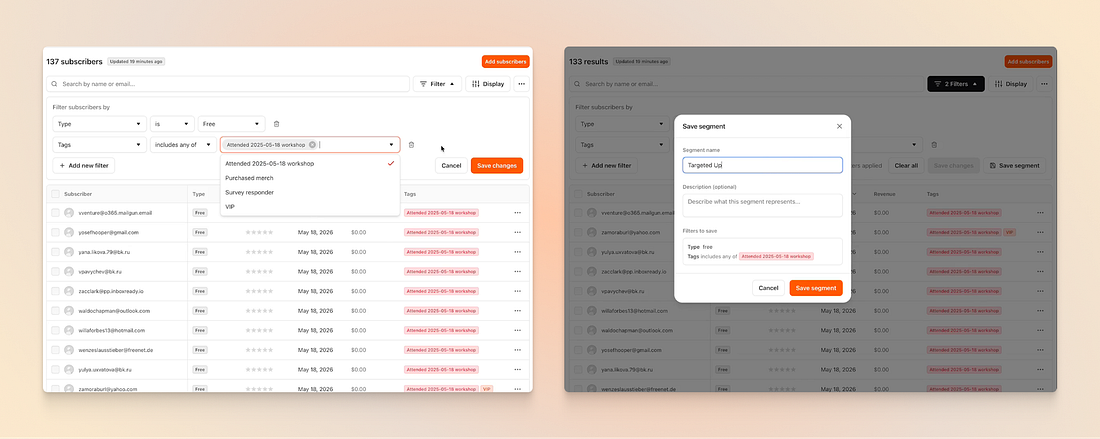 |
Justin Welsh, publisher of the saturday essay, assigns tags to new subscribers as they come in. He then uses those tags to create segments and send posts selectively to those audience subgroups.
Learn more about segments and tags in our Help Center.
Audience-specific content blocks
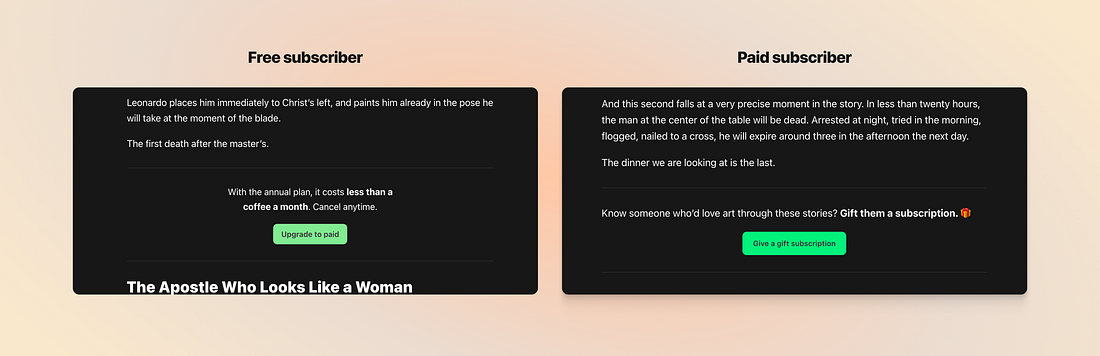
You can now tailor sections of a post for different groups without creating separate posts for each one. You can add personalized content blocks to written, podcast, or video posts that are visible based on a reader’s subscription status, including free, paid, or founding subscribers.
Cool Stories About Art uses audience-specific content blocks to tailor calls to action based on who’s reading.
 |
Learn more about audience-specific content in our Help Center.
Reply rules are available to non-English publications
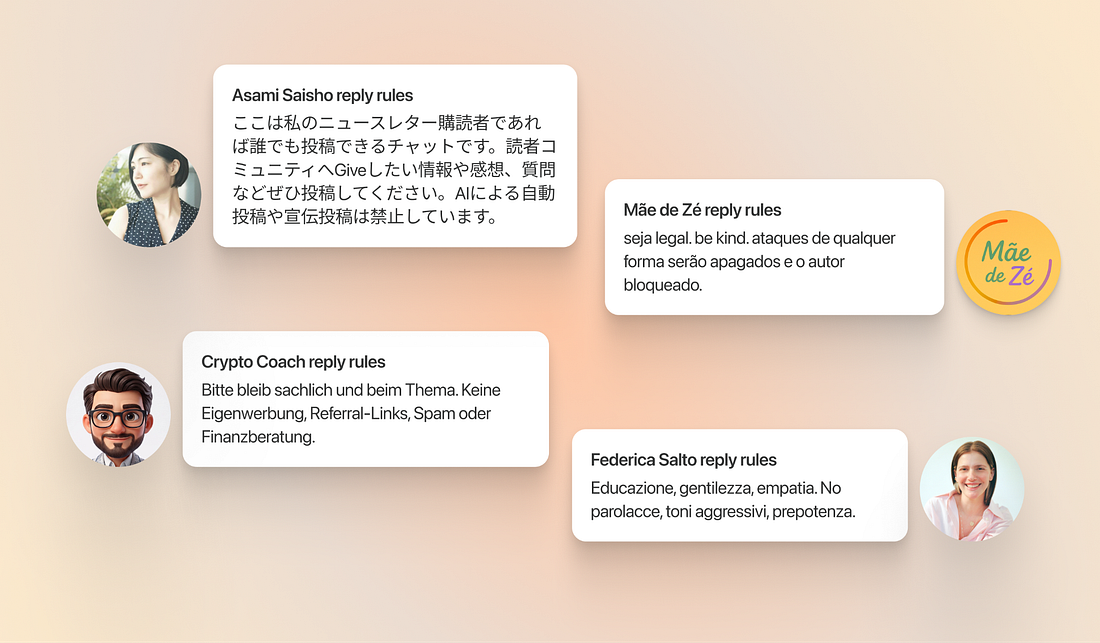
In June, we launched reply rules to help you shape the conversation happening across your Substack community. This feature allows you to set your own community standards and auto-hide post comments, note replies, and subscriber chats that don’t meet them. The system learns every time you hide a reply and preemptively moderates replies it thinks you would take action on yourself.
Now reply rules are available to non-English publications and apply to non-English comments and replies, so everyone can set the terms for their corner of the internet, no matter where they live or what language they speak.
 |
Learn more about reply rules in our Help Center.
Subscriber-only comments
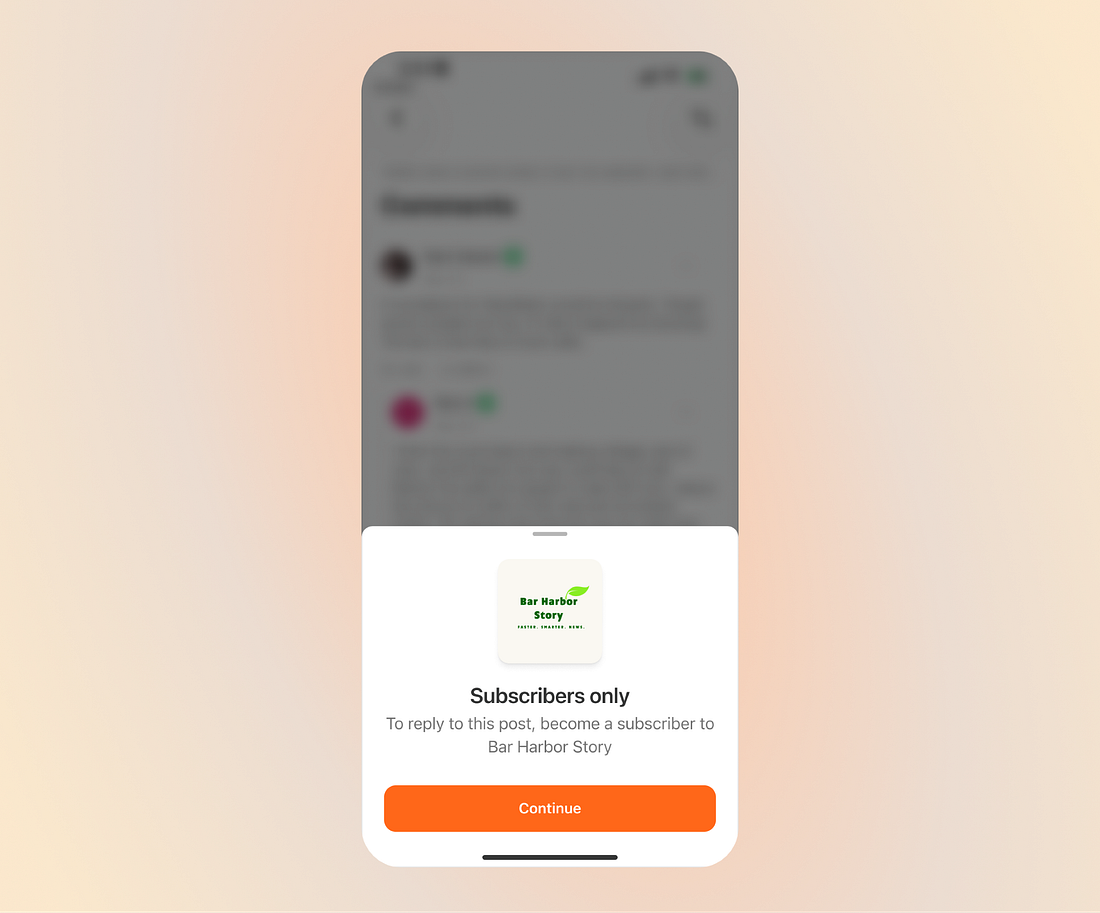
Different posts can elicit different kinds of conversation. You can now choose who gets to comment on each post, giving you more control over who participates. Set your comment section to include:
Everyone (subscribers and non-subscribers)
Free and paid subscribers
Paid subscribers only
No one
Carrie Jones, the publisher of Bar Harbor Story, a local media outlet serving the Mount Desert Island region of Maine and Acadia National Park, opens comments to free and paid subscribers.
 |
Carrie says, “Because we’re a community next to a national park, we have some hot-button issues. Having subscriber-only comments helps us cut down on bots and make community members feel safer when they comment. It becomes more like a playground with rules in the comment section, rather than a no-holds-barred WWF sort of showdown.”
Learn more about subscriber-only comments in our Help Center.
Podcast transcript advanced editing features
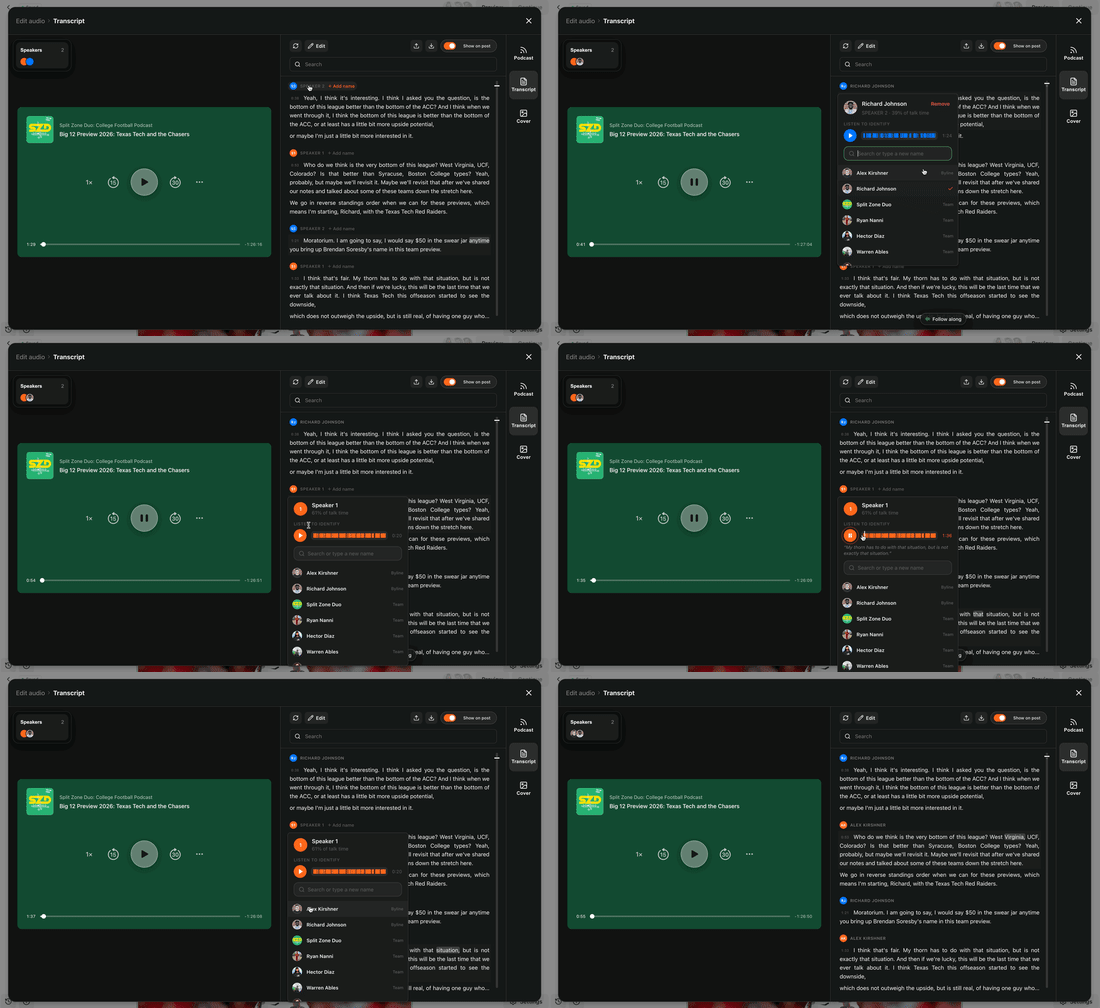
We’ve improved our transcript editing tools to make multi-speaker episodes easier to edit. You can now:
Merge speakers when our transcript generator identifies more speakers than your podcast has
Label unassigned speakers, reassign speakers, and correct labeling errors
Alex Kirshner, the co-host of Split Zone Duo, knows the pain of bad transcripts and how much time a tool like this can save a podcast creator who’s on a tight timeline covering college football: “Bad transcripts are gibberish, and a script that doesn’t understand proper nouns is useless. Every step toward a transcript that’s low-effort and high-trust is a step toward a less frustrating world. I’d much rather read my own words back to myself than endure the nails-on-chalkboard experience of listening back to specific sections or (heaven forbid) an entire show just to find something.”
 |
Learn more about advanced podcast editing in our Help Center.
Typefully partnership
Substack is now integrated with Typefully, a platform used by creators to schedule and publish content across multiple platforms—like X, Threads, LinkedIn, and Bluesky—from one place. If you write a Note or post on X sharing your most recent work, you can increase discoverability where people already follow you. This also gives your audience a path back to your Substack.
If you have a story about how a specific feature or best practice helped you grow your Substack, let us know in a Note, in a post, or by restacking. Thanks for being here.
Thanks for subscribing to On Substack. This post is public, so feel free to share it.
| |||||||
| |||||||