|



After we decided to move The Weekly Scroll to Substack, I knew we’d need to understand platform norms before committing to a voice of our own, so I dove into research on other brand newsletters on Substack. They ran the gamut, from very industry-focused to the more personal to ones reminiscent of magazines.
 |
I looked through each one to try to determine a particular style that would best fit us, and I think that naturally meant Frankenstein-ing a bunch of things together, which turned out to be the right move, not a wrong turn, because, spoiler alert: no single brand offered a complete model to copy. Each one has a specific approach that’s rich in its own right.
On this journey to post a Note-a-day, I thought it’d be interesting to share which examples I looked at within the constraint of similar models and what I’ve observed about their approach to posts and notes on Substack.
If you want a more extensive look at brand Substacks than my ten, The Brand Substack Directory is a rich resource with about 60 of them.
Thanks for reading The Weekly Scroll! Subscribe for free to receive new posts.

Rare Insider by Rare Beauty
A behind-the-scenes newsletter on product development, team culture, and mental health advocacy
Rare Beauty aims this one at makeup fans and the brand’s existing community. It’s bylined “Rare Insider,” so it reads more like a community voice than a single person’s newsletter. (The person is MacKenzie Kassab, Rare Beauty’s director of creative strategy, and by her own account, the “team” is “me.”) What I liked most is that the topics are crowdsourced straight from Instagram comments, TikTok replies, and Sephora reviews. It feels personal and responsive in a way that doesn’t come across as corporate at all. They haven’t shared totals anywhere publicly, but they told Modern Retail views are up 281% and subscribers 40% year on year.
MacKenzie’s very helpfully explained her Notes approach in detail. She’s said she thinks of herself “as a representative of the community, and that’s why I’ve been really active on Notes to have that conversation and to ask, ‘What do you want to know?’” The notes I could find match that: “Which formula do you want to know more about?”, a photo of the office toilets because readers asked, a one-liner about lip gloss. It’s less a broadcast channel and more a two-way conversation that shapes what she writes next. MacKenzie also told Modern Retail that they don’t judge Notes by numbers: “We’re measuring our success through the DMs that we get, through the comments and through the general sentiment around it.”
In Stock by Shopify
A magazine-style newsletter on entrepreneurship and commerce trends
Shopify built this for merchants and anyone “in the orbit” of a founder, and they go full magazine here, with a bylined team of writers building out recurring franchises like Commerce Current for data and Viralify for trending products. They publish two to three times a week, with posts aimed at entrepreneurs broadly, not just Shopify customers.
Their notes are sparse and mostly along the lines of “it’s live, go read it.” Their approach treats Notes as a first touch, with storytelling lead Anita Little sharing with Ad Age: “You can run smart acquisition plays, lean on Notes, get featured by other publications and still find yourself working hard for every new subscriber.” And: “Notes might bring someone in for the first time, but it’s the sense that there’s a publication with a perspective on the other end that gets them to stay.”
No Ordinary Love by Hinge
A limited-run storytelling series about real couples

Hinge produced this for a broad, mostly Gen Z audience: a limited-run editorial series rather than an ongoing newsletter, with real writers telling real couples’ love stories and a foreword by Roxane Gay. It looks and sounds nothing like Hinge’s usual brand voice, more like borrowing writers’ credibility for a moment (and their audiences: four of the five 2025 authors already had Substacks).
There isn’t a Notes strategy here, but that fits the brand. Hinge’s account posts a note when a story drops, and that’s about it. Whatever reach the series got on Notes came from other people restacking the stories, not from Hinge posting. This is not the model for us, but a reminder that a brand can treat Substack as a campaign rather than a channel and have that be the right approach for them.
La Vie de Clare V. by Clare V.
A personal, diary-style newsletter about fashion, design, and daily life
Clare V. keeps this one personal and aimed at existing fans of the brand, and nothing here feels corporate. Founder Clare Vivier writes it herself, weekly, about design inspiration and travel, to about 4,300 subscribers. She’s said she doesn’t track KPIs or follower counts (though she’s noticed interior design posts bring in more sign-ups), and she mostly replies to comments. As she told Marketing Brew, “It’s really about personal engagement. That’s what’s much more important.” It’s the closest thing to a solo creator newsletter, even though it’s technically a brand.
Everything Clare has said publicly is about comments under her posts, not Notes: I couldn’t find her describing a Notes approach at all. So the low-pressure, reply-to-everyone thing is true, but it’s happening under the articles rather than in the feed. She’s skipping the feed entirely, but it’s working!
The Sublime by Sublime
A personal essay newsletter on taste, ambition, and building in public
Sublime is Sari Azout’s newsletter for Sublime.app, a personal knowledge-management app, aimed at readers interested in creativity, taste, and modern work. It blurs the line between founder and brand almost completely. Sari writes every issue herself, mixing essays on ambition and taste with behind-the-scenes updates on building the app, and it reads like a solo creator’s newsletter that happens to have a company attached. And with tens of thousands of free subscribers, the scale backs that up. She’s said Sublime is “1% of the way” to her goal of 100,000 paying customers.
I couldn’t find a distinct Notes strategy here either. Sari frames the writing itself as the growth engine, and says consistent publishing keeps people finding Sublime.
Sequence by Cosmos
A weekly culture dispatch on design, fashion, technology, and the internet, from a visual discovery platform

Cosmos is a curation app for creatives (think a slower, more considered image-saving platform), and Sequence started life as a members-only digest before moving to Substack in November 2025 so anyone could read it. It’s written by Dena Yago, and the posts are short, cultural link roundups with headlines like “Why does everyone smell the same?” and “Clones. Costco. Cigarettes.”
Their Notes strategy involves them curating and sharing images, usually pulled from the app. It works for them, with posts getting at least a hundred likes each.
The Case by Pretty Little Marketer
A weekly marketing opinion newsletter, one argument at a time
Sophie Miller writes this under her Pretty Little Marketer brand, publishing a single case for or against something in marketing every Monday. She launched it in February as a deliberate departure from her existing audience. She already had a 30,000-person email list that drives most of her sales and 700,000+ social followers, and picked Substack specifically because she had no built-in audience there yet.
Her notes look like her posts: casual and opinionated, and all come from an account with her name on it. This account is the closest match to ours at Buffer.
Social Futures by Sprout Social
A research-driven newsletter for social media strategy and culture
Sprout Social runs this one for social media managers and marketers, and it’s clearly run like a brand newsroom rather than one person’s side project. There’s a whole cross-functional team behind it (content, PR, and social), which explains why it feels so polished and consistent. They lean into original research, data breakdowns, and interviews with social and culture experts. It’s built for practitioners, not personal storytelling: more thought leadership than diary entry.
Their notes follow the same approach. They post under the brand account, and from what I can see, it’s almost always to promote the article that just went out, either as a data-led teaser with the link or as a quote-restack of their own post with a one-line take.
The RealGirl by The RealReal
A fashion-gossip-style newsletter from a luxury consignment marketplace, written by an anonymous longtime customer

The RealReal launched this in February 2025, written in character by a real, non-employee customer who signs off “XOXO, The RealGirl.” They now publish weekly, alternating with creator collaborations.
I saved this one for last because it’s the only brand on the list that has said on record that Notes grew subscribers. Their editorial director, Sarah Leon, told Marketing Brew that using Notes and comments, plus being linked to by other Substackers, has “driven the most growth for us” over two years. Her framing: “All these posts are to start conversation. It’s just part of participating in the social channel.” The notes stay in character (“I’m about to be on Substack almost as much as I’m on The RealReal. Excited for all of us. xoxo The RealGirl”). So the one brand with proof is posting as a person who happens to be made up.
MY TAKEAWAYS
There’s no single right way to do this, and everyone’s still figuring it out.
Each brand’s approach mirrors its goal, not a universal Substack playbook. If the goal is thought leadership, Social Futures’ research-and-data model is the best reference. If it’s personality and voice, The Sublime and La Vie de Clare V. show what that looks like at different scales. If it’s a one-off campaign, Hinge shows you Substack could be a home for it.
On Notes specifically, three things stood out.
Almost nobody is doing the creator playbook. Not one of these brands is anywhere near 5–7 notes a day, and the two biggest names (Sprout, Shopify) post roughly one promo note per article under the brand handle.
The brands with the most subscribers post like a person: Rare Insider, The RealGirl, and Sophie are all brand handles with an “I” in them, asking questions and replying rather than broadcasting.
And no one is publicly measuring Notes by subscribers. Shopify calls it a first touch; Rare Beauty measures by DMs and sentiment; Clare doesn’t measure at all.
Community is our biggest goal for the newsletter at Buffer, so Rare Insider’s approach is the one I keep coming back to, though I don’t think we need to (or even can) replicate it. The Weekly Scroll already has my name on it, so the “post as a person” lane is less of a leap for us than it was for The RealReal. The plan will likely remain a note or two a day, but the mix might change. I think more questions, fewer “new issue is live” notes, and I’ll keep replying under other creators’ notes to see what happens.
💬 If you work on a brand account: are you on Substack yet, and if so, are you posting notes as the brand or as yourself? I’d love to hear from you on how it’s going!
WHERE I’M PUTTING ALL MY IDEAS
Thirty notes is a LOT. I’ve been dropping every one-liner that might become one into Buffer’s Ideas as it happens, so my daily post never has to start from a blank box.
WHAT’S IN MY SCROLL
I’ve taken my practice of looking outside writing and books into other hobbies like photography, and I photographed my friends’ wedding. Everyone’s loving it.
Meta’s introducing some updates to Edits that we’ll be able to access via their new paid subscription tier, including (gasp) a desktop version of the app.
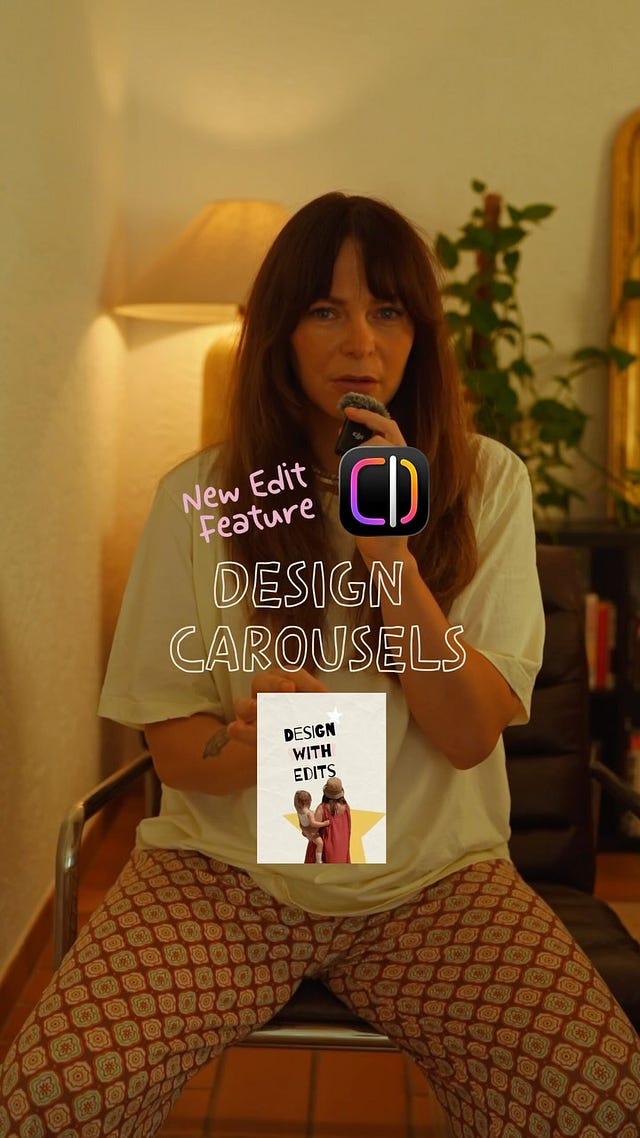
You can also now create carousels via Edits by turning on the beta feature in the app. I’ve already tried it, and while it’s no Canva (yet), it works in a pinch.
That’s all for now!
Until next week,
Tami
Sr. Content Creator
| ||||||||||