|
Open Tabs with Kevin Indig
Kevin Indig on Scott Galloway, AI slop, and 29,000 readers of his newsletter.
|

| |||||||||||||||


Open Tabs is a series under The Weekly Scroll where we peek into what a creator or social media pro has open on their browser, saved in their bookmarks, and stuck in their head right now. Each issue, someone new shows us what they’re paying attention to.
 |
This one’s a little special. Over the next few weeks, Open Tabs will feature a run of Substack writers who’ve been using our latest feature: posting to Substack Notes from Buffer. First up is Kevin Indig, writer of Growth Memo, a weekly newsletter about SEO, AI search, and organic growth, read by more than 29,000 founders, in-house SEO leads, and marketing leaders. He’s also been testing posting to Substack Notes from Buffer ahead of launch. You’ll find him on Substack, LinkedIn, and X.
So, what’s in your tabs?
Share 3-5 things that are in your tabs, bookmarks, or saved folder right now.
A bunch of vibe-coded tools for my clients
Google Search Console (Tool): for traffic patterns
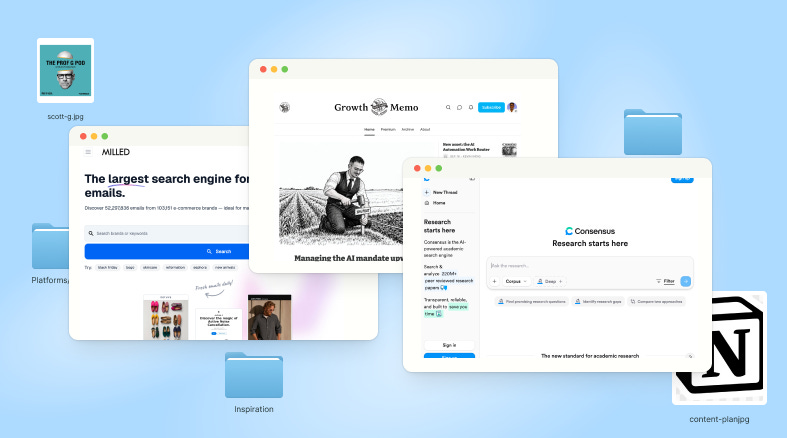
Consensus (Tool): for finding research papers
Milled (Website): for newsletter research
My Growth Memo content plan in Notion
 |
Is there a creator or account you’ve been obsessed with lately?
I’ve been obsessed with Scott Galloway for a while now. The storytelling, punchlines, analyses, and delivery are just unbeatable.
What’s one thing that’s been shaping your thinking lately that has nothing to do with social media?
How much AI slop there is everywhere. I see it in (conference) presentations, on LinkedIn, and in newsletters. Everywhere! I think a lot about how to preserve trust and stand out when so many people cut corners.
What’s one thing you’re working through or figuring out in your creator journey right now?
How to give each piece of research more time and still publish regularly. There’s always another AI search announcement to react to. I want Growth Memo to contribute something readers can use, and that often takes longer than a weekly publishing schedule allows.
 |
⚡️ If you publish on a schedule, leave a comment: how do you protect time for the deeper work?
What are you posting on Notes lately, and what’s influencing your content most?
Short takes, charts, videos, and teasers for upcoming Memos. I also use Notes to test topics before expanding them into a full article. Most ideas come from original research, client conversations, and patterns I see in the data.
How does Buffer fit into your process when a new post goes out?
A single Memo gives us several things to share. We might pull out a chart, a finding, or a question worth discussing. My team and I prepare those posts around the newsletter, and Buffer handles the scheduling. That helps when I’m traveling or spending the day with clients.
I love the MCP. Being able to connect Codex to Buffer, understand which posts perform well and get inspiration for what to post next is unbeatable.
The biggest benefit is consistency and time saved. I don’t attribute subscriber growth directly to Buffer, but it makes sure every Memo gets distributed without requiring me to be online for every post. If I had to put a number to it, I’d say Buffer saves me 2–3 hours a week.
TRY OUT NOTES IN BUFFER
The time we’ve all been waiting for (or at least the 1.1K+ people who let us know they wanted this feature) has arrived: you can now post to Substack Notes from Buffer 🎉
Try it out (and come back to let me know what you think)!
That’s it from me.
Until next week,
Tami
Sr. Content Creator
Thanks for reading The Weekly Scroll! Subscribe for free to receive new posts.

| ||||||||||