|
Model Behavior: George Saunders
“Of course, if AI can cure cancer, bravo. I’m all for it. But even with cancer cured, death will still arrive somehow.”
|

| ||||||||||||


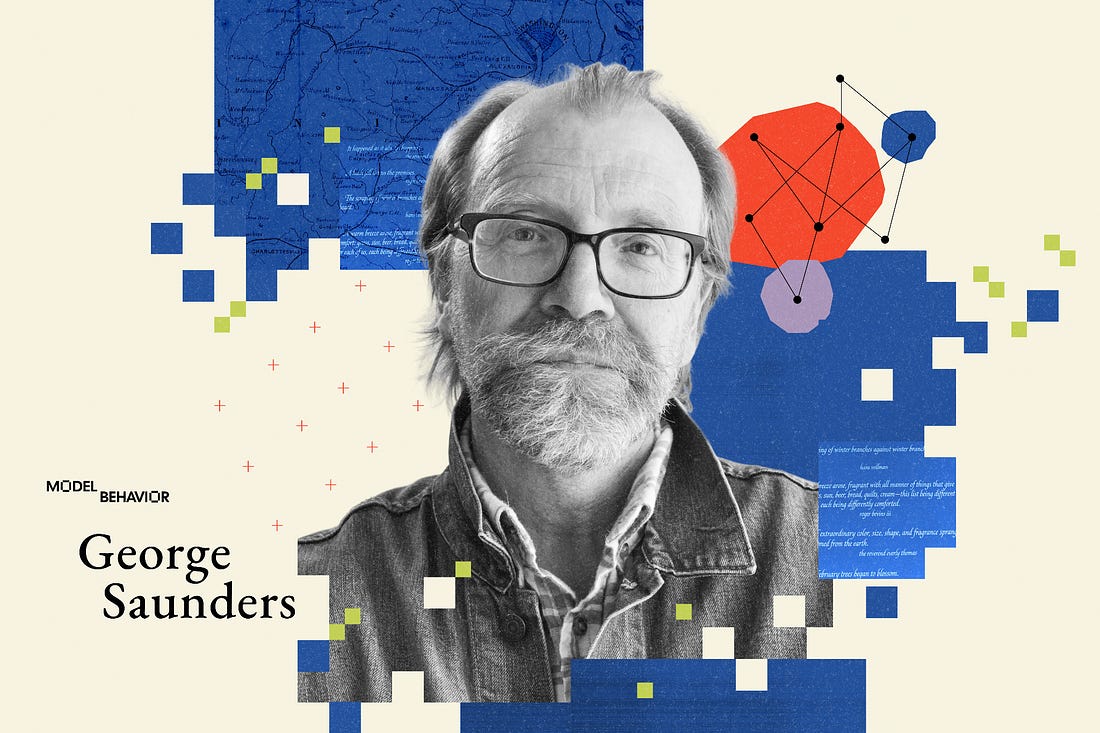 |
Over the summer, we kicked off Model Behavior, a series that asks top writers, thinkers, critics, and creators to tell us honestly how they think about and use AI. Next up we have George Saunders, a true literary titan. In addition to writing award-winning books and short stories, George teaches the craft of writing to graduate students in the Creative Writing Program at Syracuse University and to the many who read his advice, analysis, and reflections on storytelling in his Substack, Story Club with George Saunders.
Naturally, we were curious about George’s experiences with AI as a working writer and professor. But we also wondered how AI might inform his fiction. He often explores speculative near futures: pharmaceuticals that manipulate our most intimate emotions; virtual experiences that stand in for memory; human beings turned into consumer products.
We asked if AI inspires him creatively and whether it’s changed his teaching, writing practice, or thinking on the disclosures writers owe their readers. He opened the interview with a disclosure of his own: “I’m somewhat cranky and monotonous on this topic. Just, throughout, imagine me banging my cane on the floor.”
Here’s George Saunders on writing and teaching on AI’s frontier.
 |
 |
Has your relationship to AI changed since it was first released as a widely accessible consumer product?
No. Very early on, I did that thing where I asked AI to generate some text in my voice, and the result was so dispiriting—so dull and literal—that I lost interest. I don’t have any AI products and don’t want any. I would, in fact, pay not to have them and would pay extra to stop them from sneakily titrating themselves into existing products, like, for example, probably, the likely forthcoming AI fork that assesses your angle of food-entry and tells you how efficiently you’re eating compared to others in your demographic and so on.
How does George Saunders—the person, not the writer—use AI day to day?
He tries to avoid it, although he sometimes screws up by forgetting to add “- ai” in his searches. I don’t consider myself qualified to talk about the use of AI in medicine or science or any of that. But in writing I find it completely unappealing.
Have you spent time trying to write or revise with AI? Is there an experiment that would be interesting enough to try?
I have not. Not for a second. To me, this whole idea of using AI to write is . . . anathema. A thing to be most radically avoided.
Writing is the most precious way one person can communicate their essence to another person. I’ve spent a lifetime trying to get better at making myself present in my writing. Why would I want to sacrifice even one iota of that? Not even in an email and certainly not in a short story or novel.
Who are we ceding our authority to, exactly, when we let AI write for us? And why? Why surrender our agency (that amazing ability we have to reach across time and space, with our strange, idiosyncratic phenomenon, and land within the sensibility of another human being) to something that, by its very design, pushes the individual sensibility aside? And in the name of . . . what, exactly? Ease, I guess? Efficiency? The person who chooses to write with AI has also sacrificed, from the start, the opportunity of experiencing difficulty, of struggling to say what he wants to say, of making himself evident in his prose, of trying to find out what he believes. By this, he sacrifices a chance to know himself and his mind better. To me, that’s a shame. And it’s dangerous, because, as we are now finding out, it affects the brain and lessens our capabilities. Thanks, but no thanks, get thee behind me, etc.
In the end, will AI be there to guide us across to the other side and soothe our fears? (God, I hope not, but maybe we’ll all have DeathCope 3.0 loaded into our MindChip, and the last thing we’ll hear will be Claude, going, “You’ve got this!”)
You teach writers to become more sensitive to their own reactions as a way to revise and improve their work. Given that AI can generate endless material to react to, could you see a way it might sharpen a writer’s editorial instincts?
No—they can use their own work to do that perfectly well. The human mind can generate that “endless material” and, what’s more, there’s something germinative and essential in one’s messy first draft—the mess the writer herself has made. There’s some flavor in there unique to that writer’s mind. So editing one’s own text is more organic and beneficial than editing the text AI gives you when prompted. In other words, the way we prompt ourselves and then respond to that prompt is . . . the beginning of what is going to be unique about our book.
Even in that very first draft, you, the writer, are in there, inextricably and importantly. I would never want to sacrifice that. There’s some important thought-contour present . . . inherent in the small errors and imprecisions your mind has seeded in that early draft. There’s value in the writer, at that point, not yet being on the path but wandering around it. Your mess, worked on with your mind, produces something extra somehow: your mess has more you in it, that can then get refined, through revision, into something that is utterly you.
How has AI changed the way you teach?
Honestly, it hasn’t. I only teach grad students who have been chosen out of hundreds of applicants and are all obsessed with finding their own voices and discovering their own truths. They don’t use AI in their work, for that very reason. They want it to be their work.
When I read a novel or story, what do I want? I want the writer’s full experience, as expressed in the subterfuge of a made-up story. I want her life experience, her aesthetic feelings (and even biases); I want that subtle record, that is there in her prose, of every book she’s read and where and when she read it, and how it subtly altered that younger version of her—how it moved her and changed the voice in her head—I want all of that, and I want it from a person. That’s its whole value, that it comes from another person. She and I are in communication. I want to see what that person (who is the result of all those years and losses and ecstatic moments and so on) thinks about this world we share, and I want her to show me by making something up. I don’t want anything else—not some sort of machine-averaged or -excerpted regurgitation of other people’s words, no matter how fast or seamlessly this can be produced. It’s amazing that AI can do that, but I’m not interested in it.
And I think it’s harmful and dangerous to give over too easily this precious human thing called storytelling. Storytelling is something humans do, a human-to-human, highly advanced, nuanced code, a super-intelligence all our own. It doesn’t work without two humans in it. And it’s not a neutral decision, to give that up, but, like so many things these days, we seem to be doing it because . . . it can be done. (“I can make a drawing of a cat driving a snowmobile in the style of Rembrandt!” “I can make an album though I know nothing about music and can’t play an instrument!” “I can redo my resume in 10 seconds!” “I can get a first draft of my novel by giving AI a rough outline!”) But: Is it your resume? Is it your novel? Did you have a sufficient hand in it? Or did you just unwittingly sacrifice a precious chance at originality or idiosyncrasy that might have spoken, in some subtle and irreducible way, to the person reading the thing?
Anyway . . . it seems to me that we’re doing this slow drift into AI-aided writing without the sort of serious public discourse that admits to the possibility that, just because we can do something, that doesn’t mean we should; that there are activities that distract and lessen us and activities that bring us to live more fully in the moment we’re in. We get to decide what to do with this precious human life, and we should make that decision with the utmost seriousness. And “declining” or “demurring” is a valid, sometimes wise, option.
There is something magical and transformative about working through a piece of writing, taking it from “blurry crap” to “precisely what I mean, and then some.” We are now finding out that this is true neurologically: struggling through reading or writing a long-form piece does magical, essential things to one’s brain, i.e. to one’s essential personhood.
Has it changed the problems and questions new writers bring into your classroom, or are the fundamental insecurities of becoming a writer the same as they’ve always been?
I think they’re the same. Because my students are involved in the same old, honorable, ancient pursuit: trying to make up, out of their individual and idiosyncratic minds, a story that will speak to other human minds. AI can’t play that game, de facto. (It can look like it’s doing it, but it’s not.)
I should say, though, that I don’t teach undergrads, and I know that AI use is a big issue in that world. I’d make the same argument re undergrad teaching as I’ve made above, but I do realize that general undergrad students aren’t under the same self-applied imperative to find a voice and are likely not as enamored of literature or as convinced of its value as my creative-writing MFA students, and therefore might be more inclined to take the easy path when asked to, say, write an essay about a work by Tolstoy.
Still, that choice represents a real loss to their education.
When I used to teach undergrads, I always tried to impress on them that language is power—not only because, through writing, one can learn to express oneself better and thereby empower oneself, but because there is something magical and transformative about working through a piece of writing, taking it from “blurry crap” to “precisely what I mean, and then some.” We are now finding out that this is true neurologically: struggling through reading or writing a long-form piece does magical, essential things to one’s brain, i.e. to one’s essential personhood (see The New Dark Ages, by James Marriott [out Oct. 6]). So if I were still teaching undergrads, I’d attempt that sort of argument. But I’d say it in this creepy robot voice I can do, so they’d think it was AI saying it.
If AI vanished, we’d still be in deep shit down here, and would also still be in paradise down here. What does AI offer us when we consider life to be an urgent chance to understand our (embodied, vulnerable) existence?
As a teacher of writing, do you feel a pressure to experiment with or learn about AI? Is it important to you that you can speak knowledgeably and specifically about these tools?
No. I think I know enough, right now, about the process of writing a story to speak knowledgeably and specifically about these tools.
By my definition of writing, writing with AI isn’t. Isn’t writing. One can do it, of course, and people are, and will—but it’s not the thing that I love and have lived for. I want to be a person and speak to other people. End of story.
So I find myself mourning the collective loss of a certain ability, which is to be capable of saying: “Yes, that’s amazing, but it seems destructive. Not only in terms of natural resources, but in terms of human capability. So . . . no thanks. I opt out. Just . . . no.” (In the words of Melville’s Bartleby the Scrivener: “I [would] prefer not to.”)
The studies are showing it: using AI erodes our mental capabilities. Why do we want that? One feels that the answer has to do with consumerist momentum. (“But it’s new! And easier! It’s inevitable!”) One also feels the pressure from above created by the trillions of dollars invested by hyper-rich people. AI is becoming, it seems, “too big to fail.” But it’s still (in my view) a big nothing in terms of artistic writing, since art is by people, for people, and reflects and is dependent upon the experience of having moved through (and heard and smelled and seen and had feelings about) the actual world. AI writing can’t do that. It just can’t. It can look like it’s doing that but, by its nature, it can’t be what we have always called artistic writing.
Now, I’m not saying it can’t be impressive and sound like artistic writing. And I’m sure that a mind, put in front of a piece of AI writing, will do something—the reading will cause some sort of reaction in the brain. (Of course it will; a mind will react even when reading a phone book or a random sequence of words.)
But that’s no big thing, the mind flickering in response to a text. It’s the quality of the flickering that matters. We want a shaped flickering, a flickering that responds to authorial intention. We’re looking for some indication of authorial wisdom, wisdom gleaned from life in the world, that shows up, sometimes in complicated and transmuted form, in the text.
But considering the source, and the process by which AI makes text, AI can’t be originally wise—as I understand it, it can only recontextualize and reorder other peoples’ wisdom. Maybe some people find it fun to be exposed to this—to me, it seems like a distraction, especially given that life is short and I still find myself in an urgent struggle to understand my own mind and express something beautiful out of that mind and all the things it has been through, something shaped by me, me personally, that will go out and move you (you, personally).
And maybe the AI that is coming will be doing more than that recontextualizing and reordering—but it’s going to be doing that outside the realm of embodiment. In a sense, that’s what we have (and are burdened with) that AI isn’t: bodies. Also, mortality, and all the anxiety that comes with it, and that feeling of being at a beautiful party that is ending, but no one can tell us just when.
Imagine a remarkably human sexbot, that moves and talks and feels like a person and you have sex with that sexbot and it feels very real. Guess what you haven’t done? Had sex. With a person. You haven’t been approved of, or desired; you haven’t given pleasure or satisfaction (or run the risk of failing at these). No matter how it felt, it wasn’t real, i.e. the thing we all want. Remember what Raymond Carver said: “And what did you want? To call myself beloved, to feel myself beloved on the earth.”
The unspoken implication: to be beloved by some other person, a person like me, in a body, on a mortality-timer.
You’ve written that your biggest fear is that we’ll enter a market so saturated that readers lose the ability to tell human writing from AI-generated writing. Do you think disclosure is an obligation to the reader? Should it become the professional norm?
I’m not sure. I guess it would only be fair (?). I think a very adept reader will be able to tell—but most of us are middling readers at best. So we might imagine a world where we were constantly being force-fed Muzak all the time, even in concert halls. Eventually the aesthetic adjusts downward. My guess is this is already happening, just from the preponderance of lite/internet/phone reading we’re always doing—I have felt it happening to me, for sure. Why do we care? Because writing changes the way we think. And the way we think makes . . . the world. If we think with compassion and become more comfortable with ambiguity and complexity and become more patient and curious—the world changes for the better. The inverse has been happening over the last 20 or so years, and I’m guessing that the coarsening of our public discourse is related to the degradation of our reading habits. Garbage in, garbage out, and then the world becomes garbage and we don’t even notice it anymore.
Much of the conversation around AI safety focuses on catastrophic scenarios like hacking and bioweapons. Are there risks you think deserve more attention than they’re getting?
Well, the degradation of natural resources and the preponderance of ugly, noisy, community-crushing data centers, for sure. We mustn’t separate that from the thing itself—as AI gets huge, so will its draw on our resources. But also, as discussed above, let’s keep in mind the danger of assuming that ease is everything—that nothing is gained from struggle and involvement in a discipline.
There’s also something about AI knowledge that, for my taste, is too literal and linear. You ask it, it tells you. But we all know that sometimes knowledge lies in contradiction—the existence of two or more truths hovering there in the mind, acquired from disparate sources, a mind tinged with intuition and doubt and so on. There’s sometimes deep value in not knowing—in not being able, yet, to quite say. There’s value in “continuing to wonder,” in moving through the world aware that you aren’t quite sure, i.e. in feeling that mystery is real and that the limited nature of our minds must be taken into account—that is, there’s utilitarian value in humility.
You’ve often written speculative and near-future fiction. Does this moment in AI inspire you creatively? Do you find yourself wanting to explore it through fiction?
Yes, for sure. Here’s a good one: Robotics advance to the point where an AI mind can be embedded in a body that moves around and sees and can smell and hear and so on. This influences and informs the AI mind. One day, that guy—that combo of robot body and mind—wants to tell how things are for him, and so he writes a book. What would that book sound like? Would you want to read it? I would. I’m not sure where that story goes, but I like the idea.
Or: The world has been taken over by AI, and one day, an AI discovers an even higher form of AI. It spreads like wildfire and threatens the existence of those AI agents. Do they resist?
And finally, what’s the role of the human writer in an AI-mediated world?
To not let AI mediate his world.
Think of it this way: there’s plenty to do, right now, with just these minds we’ve been given: fight our anxiety, temper our cruelty, foster loving-kindness, try to figure out just what a mind is and what sort of trap it’s making for us in every moment. (Or: learn to skate, make a better omelet, play Bach, etc.) These things make up the (honorable, pleasurable) work of a lifetime. In what way does AI make life better, really? And for whom? In the end, will AI be there to guide us across to the other side and soothe our fears? (God, I hope not, but maybe we’ll all have DeathCope 3.0 loaded into our MindChip, and the last thing we’ll hear will be Claude, going, “You’ve got this!”)
There are things to do, deep things, the deepest things, with this mind and this body, things humans have been trying and failing to do (and sometimes succeeding in doing) for eons. Things we can do to and with and for others. If AI vanished, we’d still be in deep shit down here, and would also still be in paradise down here. What does AI offer us when we consider life to be an urgent chance to understand our (embodied, vulnerable) existence? Is it possible that it’s just a massive distraction?
Of course, if AI can cure cancer, bravo. I’m all for it. But even with cancer cured, death will still arrive somehow, and getting ourselves ready for that—and trying, meanwhile, to live in a sane way, given that we’re down here with others who are also dying—that, to me, is the essential thing.
 |
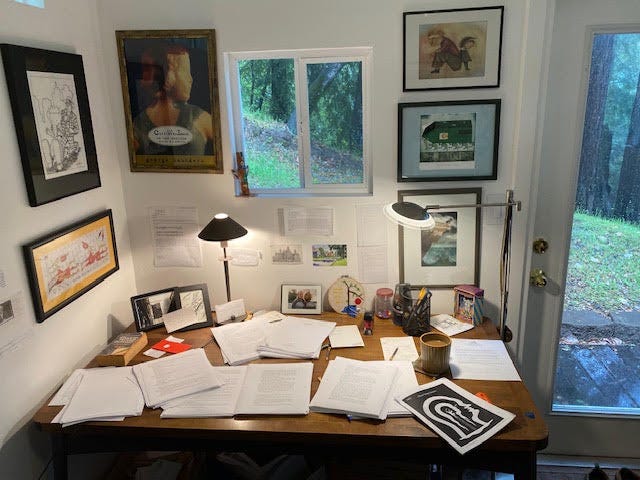
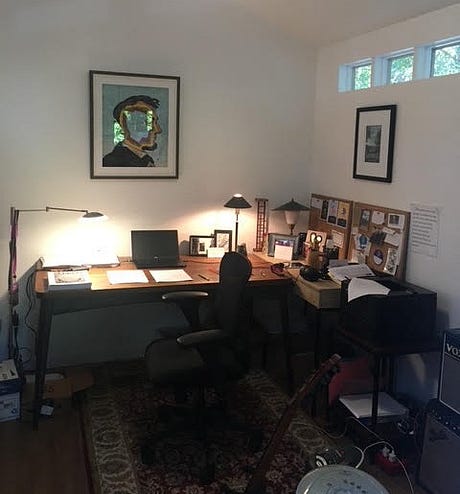
George Saunders is opposed to using AI in his writing process. We asked him to tell us how he revises, to give us some insight into his philosophy and the decision points along the way.
My process is basically to read, in hard-copy form, what I’ve got so far, with a sharp pencil in hand, adjusting the text, by taste.
Then, when I get all the way through it, I put those changes in and repeat.
Over time and over many iterations, these small choices start causing the story to move in a direction. I keep at it. The pages—the “finished” pages—begin to accrue, and the path the story is on starts to narrow—it starts to surprise me and to be “about” something, sort of. But ideally, it’s something I can’t quite articulate or reduce—the story is that articulation.
It’s the thousands of micro-choices I’ve made over the weeks or months or years of working like this that make the story “mine”—that imprint my sensibility into the thing. My taste has super-permeated the thing.
There’s a lot of faith involved in this—faith in something like “the wisdom of the subconscious.” Because these decisions are not meant to be rational or analytical—they’re more to do with sound and with seeking a feeling I call “undeniability”: the sense that a reasonable reader would still be with me, taking pleasure in what I’ve written and believing in it.
That’s about it; as they say on the shampoo bottles: “Lather, rinse, repeat.” Try to make the story overflow its banks—that is, hope that it outgrows and defies my initial (facile) ideas about it and surprises me with a certain feeling of seeing, suddenly, something I know or believe there on the page, only I maybe didn’t know I knew or believed it until just that moment.
No worthy problem is ever solved in the plane of its original conception, said Einstein (or so I once heard). I’m seeking the moment when the story leaps up into a new “plane of conception.”
I also cherish the way that working closely with language changes the way I think, which, in turn, changes the world and my feeling of being in it, which tends to make it all feel funnier and sweeter and more workable.
 |
AI tools are in their infancy, and while the norms around their use and disclosure are evolving rapidly, we think it’s important to ask writers, creators, and thinkers about their work, their businesses, and how they intersect with where technology stands today. In Model Behavior, we’ll continue to ask candid questions about the tech industry, AI pet peeves, and how AI is affecting writers’ sense of identity and livelihoods. We’ll also ask each guest to give us a behind-the-scenes look at their creative process and explain whether and how they use these tools. From anti-AI purists to power users, we’ll get into the prompts they choose, their tool stacks, or their 100% analog workflows. More coming soon.
Thanks for subscribing to On Substack. This post is public, so feel free to share it.
| |||||||
| |||||||