|
Open Tabs with Danny Hieber
Danny Hieber on 75,000 lost languages, thinking in percentages, and his newsletter.
|

| |||||||||||||||


Open Tabs is a series under The Weekly Scroll where we peek into what a creator or social media pro has open on their browser, saved in their bookmarks, and stuck in their head right now. Each issue, someone new shows us what they're paying attention to.
Thanks for reading The Weekly Scroll! Subscribe for free to receive new posts.

 |
Next up in our run of Substack writers who've been posting to Notes from Buffer: Danny Hieber, a linguist and the writer of Linguistic Discovery, a newsletter about the science and diversity of language, for anyone who wants to know how language works and the many different ways languages operate. You'll find him on Substack, Threads, TikTok, and Observable.
So, what’s in your tabs?
Share 3-5 things that are in your tabs, bookmarks, or saved folder right now.
Jane Friedman (Newsletter): Jane writes about the book publishing industry. I’m in the early stages of working on a pop linguistics book, so I’m learning as much about the industry and the process as possible!
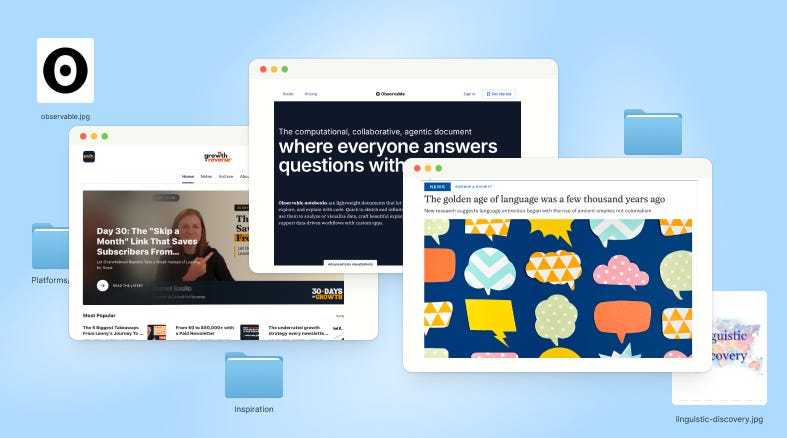
The Golden Age of Languages (Science News): A recent study estimates that the Golden Age of Languages was approximately 2,000 years ago, and there might have been as many as 75,000 languages! (Today there are only about 7,500.)
Observable (Tool): A platform for creating interactive data notebooks. I recently learned how to create maps (!) using Observable and now I’m excited to use it for all sorts of other neat visualizations in my newsletter in the future. Here’s a map I made of place names in the mystery Pre-Greek language that was spoken in the Aegean before the Greeks arrived.
Growth in Reverse (Newsletter): A newsletter about newsletters! Reading this helped me realize that starting a newsletter wasn’t as scary as I made it out to be.
 |
Is there a creator or account you’ve been obsessed with lately?
I’m continually impressed with all the other linguistics writers on Substack: Colin Gorrie (Dead Language Society), Jess Zafarris (Useless Etymology), Danny Bate, Rob Watts (Rob Words), Erik Singer (I Like Your Accent), just to name a few. They inspire me!
Over on social media, I’m obsessed with the language visualizations by Ryan Starkey (Starkey Comics), Hannah Fry‘s videos, and Good Neuroscience‘s carousels. They’re all great examples of how to create engaging educational content.
What’s one thing that’s been shaping your thinking lately that has nothing to do with social media?
Thinking probabilistically. Instead of completely overhauling a system or a habit, I’ve been trying to ask instead, “What’s a marginal improvement I could make?” or “What can I do to increase the chances that X will happen?”
Switching to a closer gym might not get me there every day, but it might get me there 20% more often. I might not read for 30 minutes every day, but if I read for 30 minutes 80% of days, that’s a huge improvement over no reading habit at all.
What’s one thing you’re working through or figuring out in your creator journey right now?
How to balance newsletter writing and book writing. The process of research and writing educational work like mine is meticulous and mentally exhausting, so I can only research and write so much in a day. I hope to use some sections of my book as newsletter issues, allowing me to double up on the work. I’d also like to create a newsletter buffer of 1–3 months, buying me time to work on my book.
If you write a newsletter alongside a bigger project, leave a comment with how you’re making it work!
 |
What are you posting on Notes lately, and what’s influencing your content most?
I’m reducing the amount of “Current Linguistics” content I post (latest news and research, new books, etc.), and posting much more of my own original content and ideas. I realized that most of my Substack readers follow me not so much for the latest news and research, but for what I have to say about it, or because they want to read my own original pieces on different topics. My strength as a writer, and the reason people value my newsletter (I think), is my ability to explain and synthesize, not because I’m aggregating links. So I’m trying to lean into that strength more going forward. And, of course, I’ll also be starting to post much more book-related content in the next year too!
How does Buffer fit into your process when a new post goes out?
I think of Buffer like my content distribution center: all my content gets scheduled there, and then Buffer sends it to all my platforms (or notifies me to post). Every time I finish a newsletter issue, I pull out all the interesting tidbits, graphics, examples, quotes, and concepts covered, and turn them into dozens of smaller pieces of content: microposts (Substack Notes, Threads, X, Facebook), carousels (Instagram), and short-form videos (TikTok, Instagram Reels, YouTube Shorts). At the end of each of those pieces of content, I include a call to action like, “If you want to learn more about {{ topic }}, check out this newsletter issue.” I then use Buffer to trickle that out over the following weeks.
It might seem strange to say, but Buffer has done wonders for my mental health! It frees me from the stress of feeling chained to my content schedule. I schedule batches of content in advance, so at any given time I might have several weeks’ worth of content in the queue, and I no longer have to worry about missing a day or two. Before using Buffer, my content schedule never felt sustainable. And what I love about the platform overall is that it saves me from hardly ever having to open the social media apps themselves. Hours of distraction and doomscrolling avoided!
TRY OUT NOTES IN BUFFER
The time we’ve all been waiting for (or at least the 1.1K+ people who let us know they wanted this feature) has arrived: you can now post to Substack Notes from Buffer 🎉
Try it out (and come back to let me know what you think)!
That’s it from me.
Until next week,
Tami
Sr. Content Creator
| ||||||||||