| Is tapping into scandal a good marketing idea? |
Presented By |  |
Today is Thursday. Pringles’s Halloween campaign is offering one brand fan the opportunity of a lifetime: to be laid to rest in a Pringle-can-shaped urn. The winner of the contest will also receive a 200-year supply of Pringles—so here’s hoping they’re chock-full of preservatives. In today’s edition: —Jennimai Nguyen, Alyssa Meyers |
|
BRAND STRATEGY Get them talking 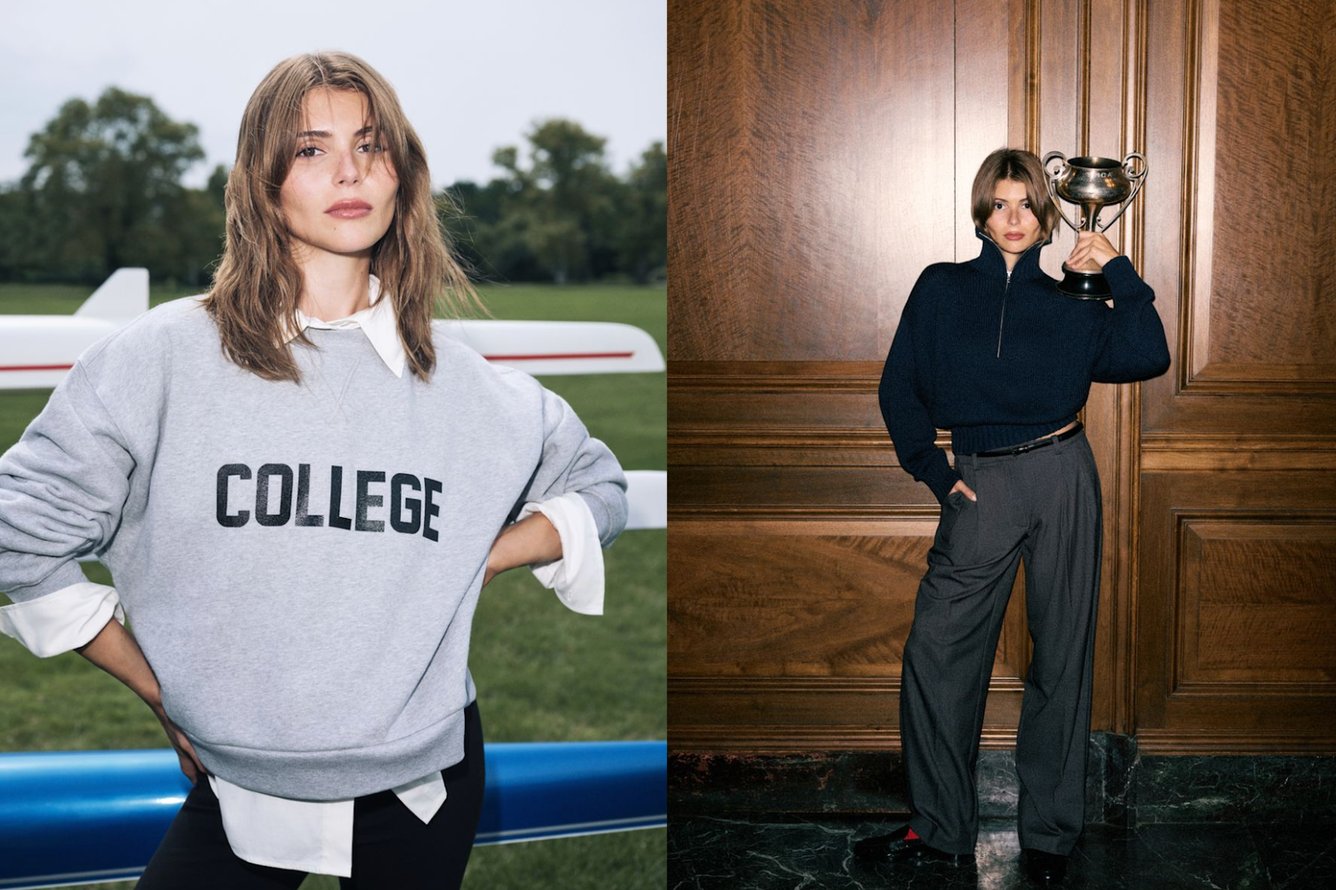 Reformation | In 2019, influencer Olivia Jade Giannulli found herself at the center of a now-infamous college admissions scandal. Her parents, Full House actress Lori Loughlin and fashion designer Mossimo Giannulli, pleaded guilty to conspiracy to commit fraud in the federal case now known as Operation Varsity Blues that revealed a widespread ring of cheating, fraud, and bribery involved in gaining admission to some of the country’s most elite colleges. When the scandal broke, public opinion and the court of law quickly turned against Olivia Jade, whose admission to the University of Southern California had been bolstered by a fake recruitment to the school’s rowing team, and her family. The popular YouTuber soon unenrolled from the university and took a social media hiatus. Fast-forward to 2026, and Olivia Jade is back—and the star of Reformation’s fall campaign, called “Good Sport,” which prominently features a crewneck sweatshirt emblazoned with the word “College” and has copy including “We brought her back to campus for a lesson in dressing for sport.” It’s an unsubtle reference to the scandal that rocked the academic world, and judging from comments on Reformation’s Instagram post introducing the campaign, it has audiences split, with some labeling it iconic, and others decrying it as insensitive. Time and time again, brands tap into scandal in campaigns to drum up attention and conversation—but not all views are equal, according to Derek Rucker, professor of entrepreneurial studies in marketing at Northwestern University’s Kellogg School of Management. “People will sometimes ask, ‘But isn’t any publicity good publicity?’” Rucker said. “The answer to that is definitively no.” For more on the balancing act for brands that look to balance buzz with controversy, continue reading here.—JN |
|
|
Sponsored By Contentful Question and answer and AI  | Contentful’s latest report helps break down the five questions marketing leaders need to answer to succeed in the agentic web era. They surveyed 350 organizations and found a few recurring themes, like: - What can agents do without us?
- What has to remain human?
- Can the agentic web understand and verify our brand?
- What do AI systems say about our brand, and how is that changing?
- Who is accountable for keeping the system aligned?
Answering these five questions doesn’t require a budget. It requires an operating decision on each: what’s been decided, who decided it, and when it’ll be revisited. This report helps you explain what you need to decide, the risk of deferral if no one makes a call, what success looks like, and the review cadence needed to stay on top. Download it here. |
|
|
SPORTS MARKETING Less is more 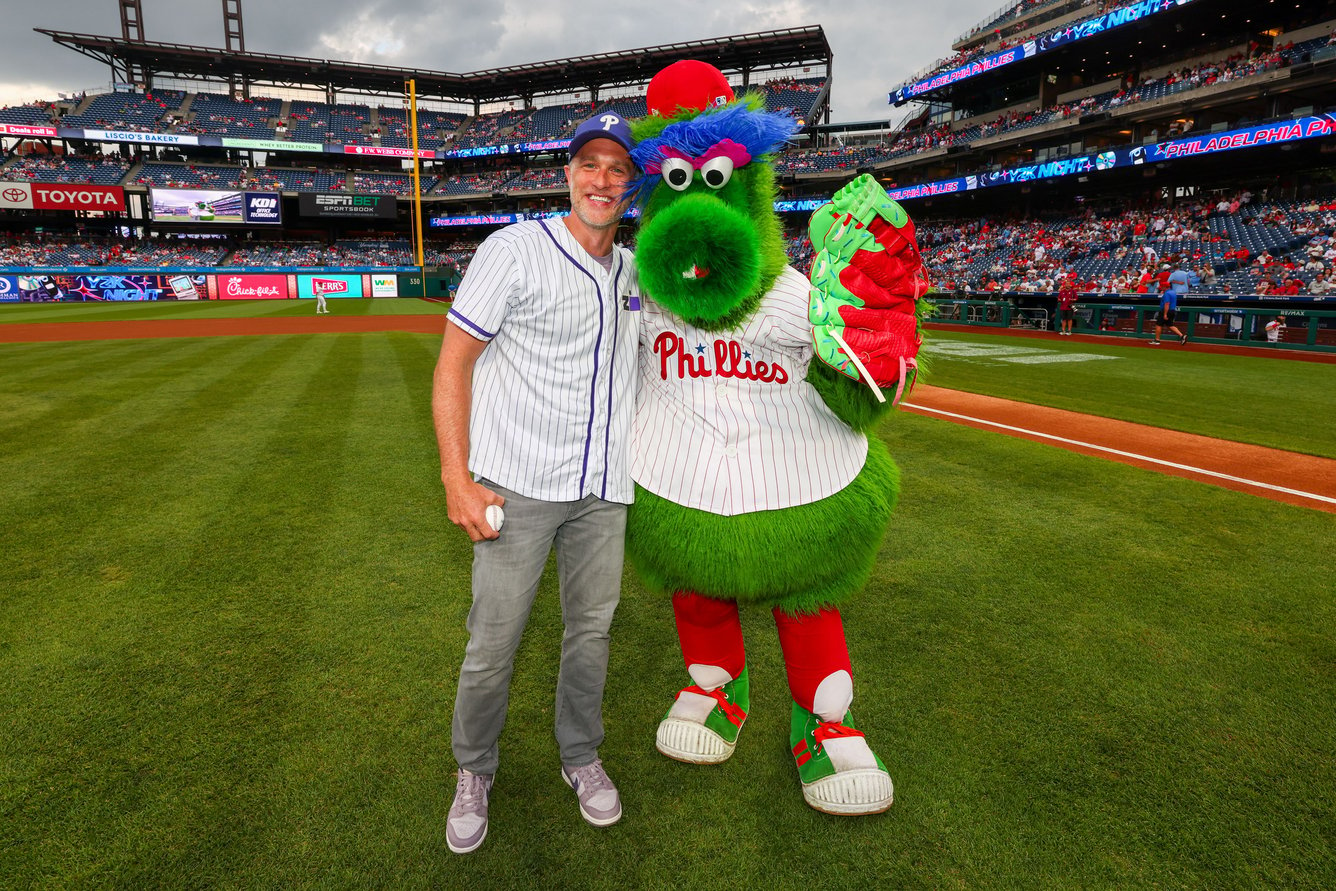 Zip | Many major sports sponsorships are designed to generate brand awareness across the country, if not the world. Zip, a digital financial services company known for its buy now, pay later product in the US, got in the sports game for a different reason. “We are not right for everybody,” Chief Marketing and Customer Officer Jinal Shah said. “For us to be responsible marketers, it is not a spray-and-pray…Awareness with the right audiences, at the right moment in their journey, is even more important than broad awareness.” Because Shah and her team are more focused on product consideration and preference than awareness, they’re taking a “surgical and strategic” approach to sponsorship, homing in on just a couple of key regions where they’d like to build a deep brand presence, she said in an exclusive conversation with Marketing Brew. Zip’s recent partnerships so far have been primarily concentrated in Philadelphia, including deals with the Phillies, the Flyers, and Xfinity Mobile Arena. Today, the company officially added the 76ers to its roster. “The timing was critical,” Shah said. “They open their first season with LeBron James on October 20, and him joining this season made the timing just perfect for us to figure out how we integrate on the ticketing system, which is where payments can play a major role.” Click here to read more about Zip’s “surgical” approach to sports sponsorships and how it’s paying off.—AM |
|
|
Sponsored By Outreach  | AI that helps get the job done. Most AI tools stop at just answering your questions. Agentic AI does more. See how Outreach’s own GTM team deployed purpose-built AI agents across their revenue funnel to help with work that actually matters, like outbound prospecting and retention and expansion. Watch the on-demand webinar. |
|
|
MARKETING BREW WEEKLY Merch worth the purchase 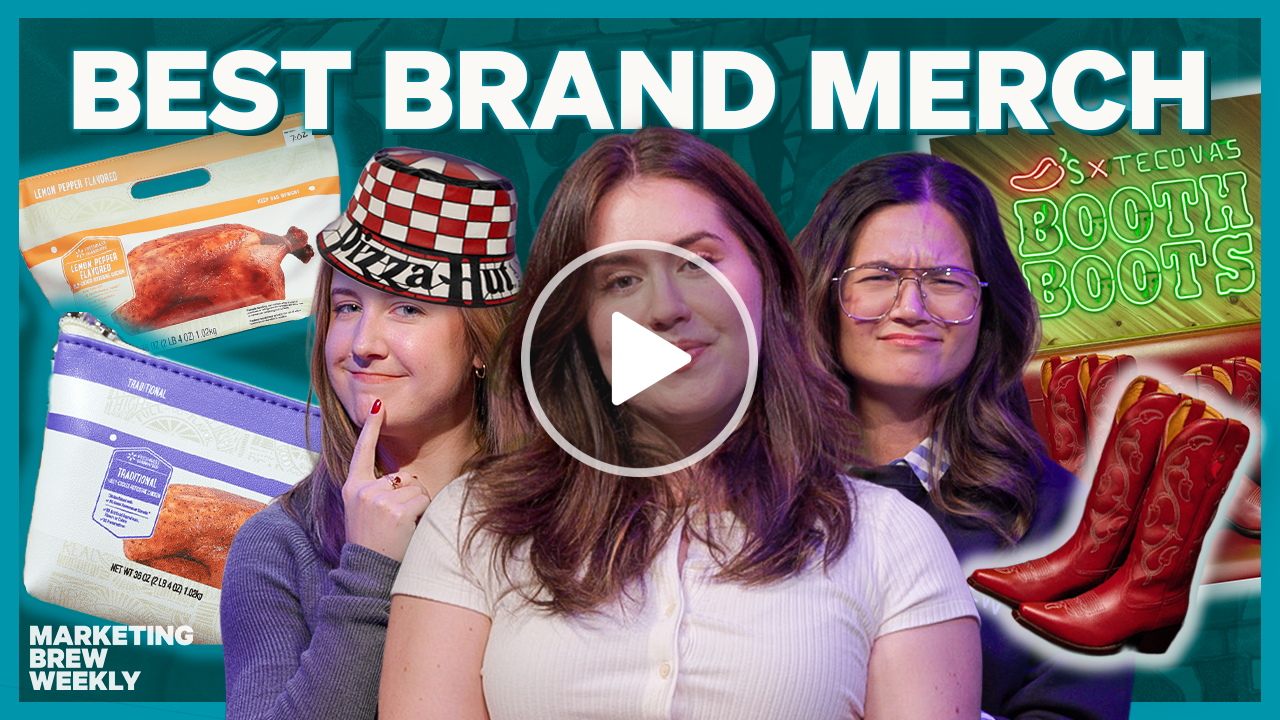 | Brand merch has officially outgrown the free tote. From Walmart’s $5.97 rotisserie chicken purse to Chili’s boots made from the actual booth leather, brands are making more branded stuff than ever—and a lot of it still ends up in a landfill. In this episode of Marketing Brew Weekly, Katie Hicks, Jennimai Nguyen, and Kelsey Sutton play “Love it or landfill,” sorting good merch from bad across Starbucks tumblers, Patagonia branded vests, Fishwife totes, and a Cosmo-branded yogurt crossover from 1999. Here are some takeaways on what separates the keepers from the clutter. Subtle beats loud. The best merch is the kind people forget is branded because it blends into their lives instead of turning them into walking billboards. Category fit matters. Collabs and brand merch drops land when they feel like a natural extension of the brand, and when a brand’s fandom already overlaps with its partner’s (think Whole Foods x Fishwife, or Chili’s x Tecovas). Cosmo’s yogurt is a different story. Scarcity and social listening drive sellouts. Walmart built its rotisserie-chicken-bag purse off 15,000+ organic mentions, and it sold out in 90 minutes. Limited, in-store, and drop-style releases create buzz that outlasts the product. Merch has a sustainability cost. Patagonia stopped adding corporate logos to its vests because non-removable logos shorten a garment’s life—a good reminder to design merch people may actually keep. Listen to our full conversation on Marketing Brew Weekly here. |
|
|
Sponsored By Profound 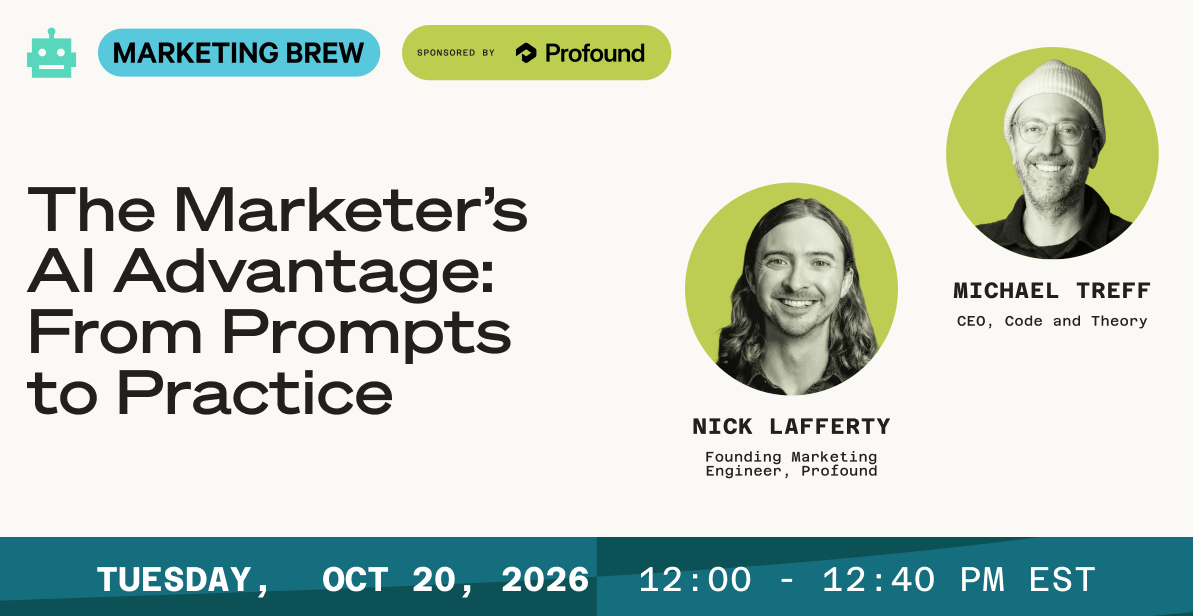 | The AI factor. Profound joins Marketing Brew for a virtual event to explore why product information, customer knowledge, brand guidance, and human review can matter more than ever to the quality of AI-assisted work. Plus, learn how to foster an environment where all of these key elements work as one for marketers. Register here. |
|
|
french press  | There are a lot of bad marketing tips out there. These aren’t those. Buy this, not that: A roundup of viral products currently resonating with customers on social media. Turn it up: Some songs to put behind Instagram posts this month. Test-taking: Understanding common mistakes that could impact SEO experiments. *A message from our sponsor. |
|
|
Jobs  | Real jobs shared through real communities. CollabWORK brings opportunities directly to Marketing Brew readers—no mass postings, no clutter, just roles worth seeing. Click here to view the full job board. |
|
|
WISH WE WROTE THIS  | Stories we’re jealous of. - Bloomberg wrote about how Meta and OpenAI are using cute avatars as a way to encourage people to adopt their technology.
- The Verge broke down how an AI-generated image of actress Mia Goth, which was posted on a verified Instagram account, spread across the internet.
- The Atlantic wrote about the rise of “IRL influencers.”
|
|
|
Share the Brew

Share the Brew, watch your referral count climb, and unlock brag-worthy swag. Your friends get smarter. You get rewarded. Win-win.
Your referral count: 0
Click to Share
Or copy & paste your referral link to others:
marketingbrew.com/r/?kid=4a79007d
|
|
|
|
|