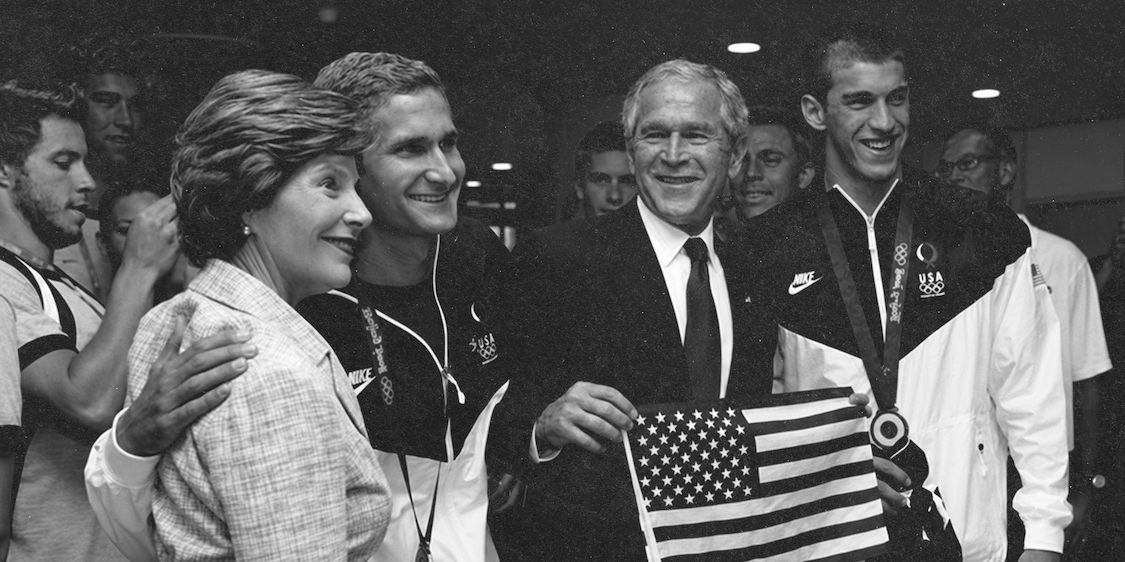
Larsen Jensen is a venture capitalist, Olympic medalist, and former Navy SEAL. He is the founder and Managing General Partner of Harpoon Ventures, a San Diego-based early-stage firm with approximately $450 million under management. Since 2018, Harpoon has had numerous successful exits, including Airplane, Bluesky, and Truera. Its portfolio currently includes numerous defense and space technology companies like Astranis, Aalo Atomics, and Starcloud.
I sat down with Jensen to discuss the defense tech ecosystem, his military service, and how to deal with challenges. What follows is a transcript of our conversation.
CB: Would you say that swimming was the formative experience in your life?
LJ: It for sure was. The obvious reason is that it was the first time in my life that I saw the direct correlation between hard work in and high performance out. Learning that at an early age is extremely important. I try to instill it in my kids. Small things compound over time. It's hard to find that lesson anywhere in life, and to experience it as concretely as you do in swimming.
Swimming is a time-based sport. Your time is your time. You know if you're good or not based on what your time is. It's not like gymnastics scoring or diving scoring, or team-based sports, where you could have a great pass but maybe someone doesn't catch it.
CB: At what point did you decide to take it to a higher level, where you were training for and entering the Olympic team?
LJ: It's a good question, because I'm not so sure if it was a decision or circumstance. I think it's actually a combination of both.
I started swimming relatively young compared to my peers — compared to the Phelpses and people like that, who ended up being my peers at the tail end of my career. But I didn't start doing year-round swimming until I was in high school.
It was probably junior year that I really came onto the scene. I think it was between my sophomore and junior year that I made my first nationals. I was fortunate that I earned rookie of the meet at that event by finaling in a couple of events, which is sort of rare for a first-time person who goes to nationals.
And then I believe it was my second nationals where I made my first international team representing Team USA, which was traveling to Japan. I still remember my mom, in her wisdom, getting me a passport. I'd never been out of the country. I grew up in a rural area in Central California — my parents were almond farmers. Fortunately she did, or else I wouldn't have been able to go to Japan for my first international competition. And that's when I was 16 years old.
So around that time is when it became evident that swimming was something I was pretty good at and had worked hard at. And just for context: if you make the national team for any of these international competitions, it's the equivalent of making the Olympic team in terms of the tryout process. But the pressure at the Olympic trials is a whole other level.
CB: How do you feel before you compete at that level, where a single performance decides whether or not you get to go and do this incredible thing?
LJ: Jumping ahead a little bit — it's probably the same way as when you go into something in the military. You trust your training, you know you're well prepared, and you don't hope to rise to the occasion. You plan to fall back on your training. So much of it is muscle memory, so much of it is preparation. It's definitely nerve-wracking, but also exhilarating, and something that I very much crave and I miss.
CB: How do you compare Athens and Beijing? I know the latter had a little bit more of a geopolitical bent to it, with China's rise.
LJ: My first Olympics being at the birthplace of the modern Olympic Games in Athens, Greece, was super, super cool and really historic in that regard.
On the other hand, going to China for what was effectively their coming-out party — it was when they were starting to resurge as a leader on the global stage. It was much less obvious then, compared to now, 20 years later, that they would be potentially our only economic competitor and potential adversary on a global scale. It just felt like they were coming onto the scene, and they invested — at least at that point — more than any other country had done in terms of putting the Olympic Games spectacle on for athletes and spectators.
I did better in 2004. I got to chase after Grant Hackett, the world-record holder. He set the Olympic record for that race, the 1,500-meter freestyle. My time was right around there — I lost by a second and a half. I look back on that almost like, you know, in Rocky, going the distance. I didn't win. Rocky didn't win — and then Rocky won. But he went the distance with Apollo Creed, and I look back on that as: I went the distance with the greatest distance swimmer of our era, Grant Hackett. And I'm really, really proud of that.
2008 was unique for a whole lot of other reasons. It was my last Olympics. It was actually my last race. I knew I was going to be done after that. So that's sentimental.
CB: You had the Winklevosses there too, right?
LJ: Who would have thought, right? It was a really formative Olympics for many reasons. I had the opportunity to meet President Bush and all that, and I got bronze, which I'm super proud of — but never had the United States flag fly and our American anthem play for us, or for me. But I got to witness Michael Phelps and be a teammate to him and a bunch of those folks, and I actually became pretty good buddies with the Winklevoss twins during that Olympics as well.
At the time I didn't really know that they originated and started the Facebook idea; the movie came out later. I remember spending some time with them in New York a few years later; I think I had finished SEAL training at that point. And they're like, "We're going all in on this thing called Bitcoin."
CB: Did you buy some Bitcoin?
LJ: I really didn't. I wasn't really in the tech investing frame of mind at that point. I was getting ready to deploy to Afghanistan. We all have regrets; not listening to smart people in my orbit at that time is probably one of them.
CB: Obviously, you dedicated most of your energy to swimming for years. How did you decide to call it? That's got to be pretty emotional, to say, "All right, I'm done."
LJ: Yeah, it is. For better or worse, I have never really had a problem with that. I've always been okay walking away to start the next adventure and to dedicate myself toward the next thing — at least as it goes from swimming to the SEAL teams, and from the SEAL teams into tech. I've never really had difficulty going back and having remorse about that, or wanting to go back and have a comeback in swimming.
I think that's something that I've been fortunate to have in me, because I know it's not always the case. A lot of people, whether it be special operators or military folks or athletes, struggle to find that next calling.
And it was very hard for me. Probably the hardest for me was leaving the military and going into the private sector, and feeling that sense of camaraderie, self-worth, belonging, accomplishment all over again. It's a lonely feeling. So it was a tough couple of years until I really found what I feel like is my third and final career act.
CB: How do you compare the challenge of training and competing at the high end of the Olympic level with military training, things like BUD/S? Is it a different type of challenge?
LJ: I wish I could give you an absolute answer and say one is for sure harder than the other, but I don't think that's accurate.
I think swimming is harder, in my experience, because of the time duration you have to put into it before you have any sort of positive feedback. It's every four years between Olympics. In the case of swimming, you're waking up at five, hitting the pool at 5:30, sometimes even earlier, and swimming for a couple of hours. Then going to class and all that stuff, and coming back and getting after it again for another couple of hours. And you just do that day in and day out, week in and week out, month in and month out, year in and year out, to get ready for one race — which you may or may not make.
That takes a lot of dedication and focus. Football players do a game every Sunday. Swimmers have years before our equivalent of the national championship or the Super Bowl. I think a lot of guys, myself included, struggled with that.
From a SEAL standpoint, going through BUD/S: nothing's harder than Hell Week, to me, in terms of any of the training that I did for the Olympics. We definitely had hard workouts, hard weeks, hard months, hard years — but just the raw intensity of doing a week straight, effectively, of three to four hours' total sleep for the entire week, and being physical the entire time. It's a meat grinder, and you definitely have to earn it to make it through and earn the SEAL Trident. So that's probably the hardest singular event that I've done — Hell Week, from a physical and mental conditioning standpoint. But the duration is just a whole other animal when you're competing to make the Olympics.
CB: How does that sleep deprivation and training translate to actual combat, actual deployment experiences?
LJ: Turns out no sleep is bad for you, man. That's not good.
But I think it translates pretty well, because you're training for a worst-case scenario. You're training for a scenario that, unfortunately, many brave people have encountered, where you're on ops for a long period of time and the worst happens, and you lose guys, and you have to be prepared mentally, physically, emotionally to navigate through that and never quit, even when things are really, really bleak.
And so Hell Week is a microcosm of that. That is not the norm — that level of sleep deprivation and having to perform at an elite level week in, week out, or through the course of an entire combat tour. But you're preparing yourself for the worst, and always having that in the back of your mind: that you've been through something extremely arduous with people who have also been through it with you, who you know you can trust and depend on. They would rather die than leave you behind, and would rather die than quit. And you need that when you're going into harm's way — that mutual trust, not only in your peers, but in yourself.
CB: You jumped into the service at a very interesting time, halfway through the Global War on Terror, during a technological renaissance where digital was being integrated into the battlefield. I'm assuming they trial a lot of new tech on the SEALs. What did you learn about tech in particular from your military service?
LJ: I felt this huge debt of gratitude to have the opportunity to represent our country on the international playing field and at the Olympic Games. And I felt like I had to do something to give back to my country.
And we were also in a time of war. Who would have thought how long the conflict was going to go on? It went on for almost 10 years after I went in, in '09. So it sounds a little bit ridiculous, but I thought I had missed it. I thought I had missed the opportunity to sign up and serve in combat alongside some of these battle-hardened warriors. But in hindsight, we were only sort of halfway through.
I don't even compare myself to them — I'm not at all a battle-hardened hero like the guys that I served with. But I was lucky to have many people in my platoons, and training us, who are among the most decorated veterans of our era. So it's really a humbling thing to be a part of.
But as it relates to the technology component: we didn't really have a lot of the things that we're now developing in the tech ecosystem, and we fought against a rather non-technical enemy, and they were still extremely effective against us. Elon had a quote the other day that I actually disagree with — that technological superiority is the single determinant of warfare success broadly. I can see the point, but the enemy always has an opportunity to adapt. And interestingly, they did it quite well there, with IEDs and insurgent tactics that overmatched our technological superiority in many ways, and just made it into a long, drawn-out conflict where there was no smooth off-ramp.
So we had total technological superiority: Predators, Reapers, total air superiority, night vision, optics, way better training, way better conditioning, way better diets. You name it, we had it. And the enemy — being Al Qaeda or the Taliban — didn't have any of that. But that doesn't mean they weren't tremendously successful against us, to the point where we all saw the Afghanistan withdrawal. That was pretty embarrassing.
So out of that experience — and seeing in some ways the things that we had right, that were super cool, and every little boy's dream to get to use, shooting guns with lasers on the end of them with night vision; I mean, it's super badass — but at the same time, we also had a lot of legacy technology that seemed to be from Gulf War One that we were using. That experience, plus that curiosity, is what drew me to the tech ecosystem in Silicon Valley, to see what the frontier of technology really was, and how that would impact not only the defense ecosystem but also our economic standing and geopolitics broadly.
And what I found was exactly that: that this modern era of technology was going to have much higher consequences than I think anybody else realized. The new space race that we have — thank goodness we have SpaceX and Elon. The nuclear renaissance that we have now to bring energy abundance online. The AI race that just keeps accelerating on a daily basis. It's a remarkable time we live in.
CB: Did you use Palantir Gotham?
LJ: We did. On my second rotation, I managed a cross-functional intelligence team, so that was part of the suite of products that we used. Obviously it was extremely effective. It really reduced the man-hours — the number of people that we needed to synthesize information into actionable intelligence for targeting purposes.
Back then, I think it was really the only notable defense tech company. There really wasn't anybody else that was venture-backed that I knew of at the time that was making a difference in that space. Lots of smaller technology vendors that had point solutions, but nothing that was really making a holistic improvement to how we did a core part of our mission.
CB: How did you make the leap from military service to being a VC?
LJ: I think it's very similar, actually. At one point I woke up and said I wanted to be an Olympian. At one point I woke up and said I wanted to be a Navy SEAL. At one point I woke up and said I wanted to be a VC. I could probably read into all of those decisions and give you logic and reasons, but there was just something that called me to want to do those things.
I had some friends of mine from undergrad who were startup founders — they had started a company and sold it and done well — and they started to educate me about the tech ecosystem, what venture was. And I just became enthralled with the concept of investing in innovation, and investing in people who are brilliant folks, who are the Navy SEALs or Michael Phelpses of their domains, and being their partner in some capacity.
So in a lot of ways, I think the way I have learned to find my sense of belonging — just like I did in the swimming pool with my Olympic team, or in the SEAL teams with my team of other operators who were going into harm's way — is to be that teammate to founders who are equally audacious and trying to win their version of a gold medal. And most commonly not because it's financially lucrative. It's just because they want to win. Nobody swims for an Olympic gold medal to make a lot of money. They just want to be the best, and they dedicate their lives to being the best. And I see that in the founders that we invest in, or that we're trying to find. There's something raw and ultra-simple about that that's exciting to me.
CB: We were talking a little about psychology earlier. How do you compare the challenge of placing a high-risk bet — where you stand to lose maybe a lot of money — with the other risks you've taken? Is it a different psychological profile of risk?
LJ: 100%. It's way different.
CB: It's not physical risk.
LJ: Yeah, it's not physical risk. In the military, we mitigate risk as much as we possibly can. There are go/no-go criteria for every single operation. You have contingencies for every phase of the operation. You train to it. And still, edge cases occur, and the enemy gets a vote.
So I actually think that preparation process is well suited for venture. We mitigate risk as much as we can, but different from the military, we need to take more risk in venture, because the losses don't matter — it's how big the winner is. You sort of know how big the payout could be on a bin Laden raid — which I was never a part of, but fortunately I had some buddies who were. You know what you're going for. That's the unicorn op. That's the payout. And you obviously don't want anything bad to happen to anybody.
But in startup world, there is an unknown upside when things go well that you just can't forecast or predict. And I think we need to be more risk-seeking as venture capitalists and as entrepreneurs, and I myself need to be more risk-seeking with that, because only by investing in people who are truly special can you have the creation of these world-changing companies. So that's something that we talk about every single day as a team: how we can be more risk-seeking while also making sure we mitigate things that could go wrong as best we can — just like a combat operation.
CB: With the Global War on Terror, and then now with Ukraine and the war in the Gulf, we've started to see a really profound change in how wars are fought. As a former SEAL and as somebody who's actually investing in these companies — what's really happening in warfare? What are the major trends that we need to understand to appreciate what's happening right now?
LJ: I think the Russia-Ukraine conflict is going to go down in history as Drone War One.