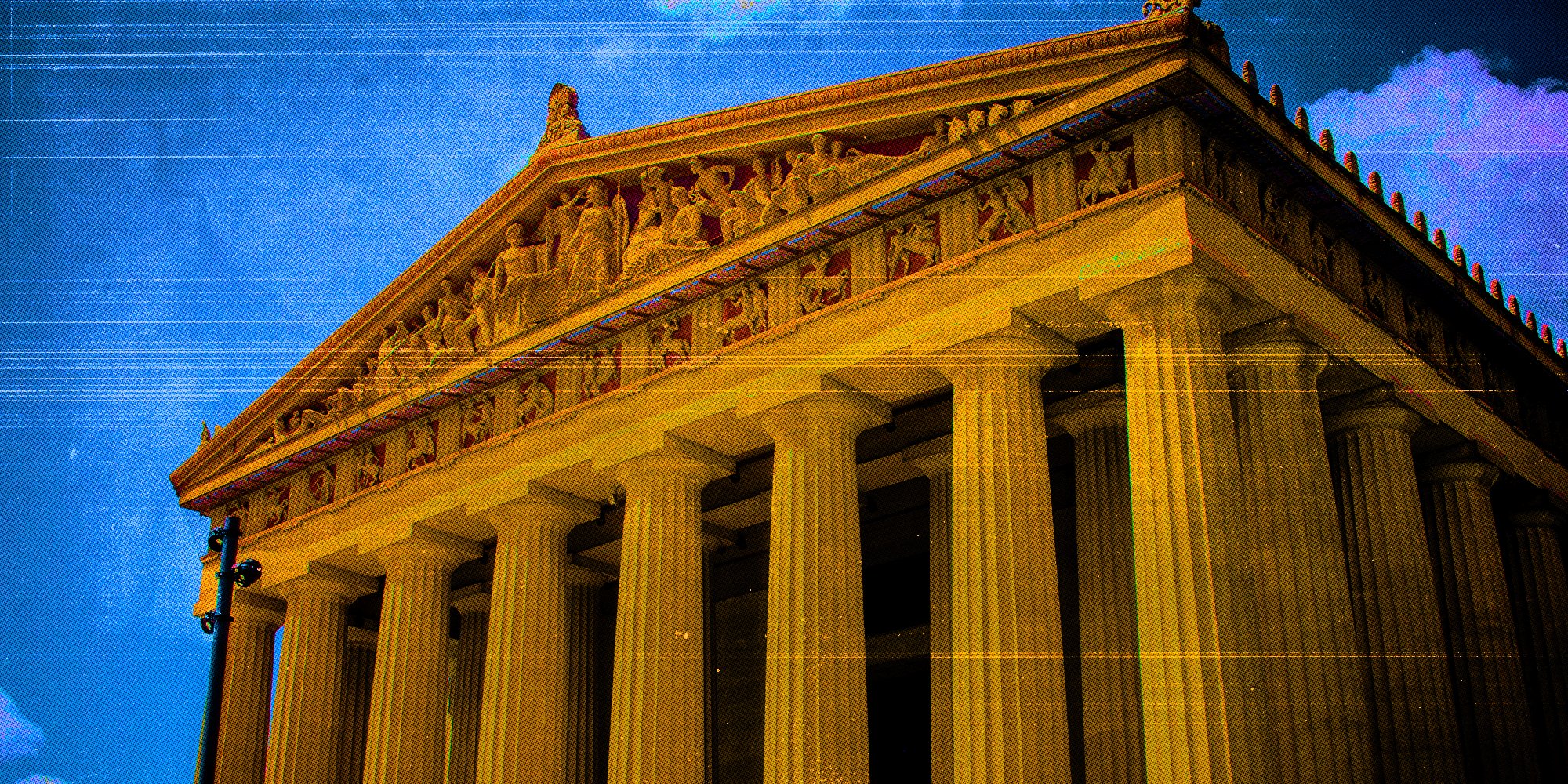
For the last four Mondays, in a vault-like neoclassical building that houses the Masonic Grand Lodge of Tennessee, behind a perimeter of armed guards and metal detectors, Peter Thiel held court in downtown Nashville before an audience as captivated as it was varied.
Among the crowd: out-of-town tech bros, writers, and online influencers; throngs of married couples from the Nashville suburbs, local pastors, college students, and musicians. They were sporting everything from suits and ties to Ted Kaczynski T-shirts, neck tattoos, and boot-cut jeans. A few blocks away lay the neon signs and booze halls of Broadway, with its live music and hordes of drunken tourists: the permanent, daily replication of the best of an American college town on a Friday night, busy even on this fine succession of autumn Mondays. So close to that carefree revelry, the weight of Thiel’s words could seem jarring.
“I’m worried about the Antichrist,” he said. Over four weeks as the weather started to turn, he explained why.
Versions of these lectures focused on the biblical Antichrist had previously taken place in Rome on a secretive, invite-only basis and in San Francisco last year (that event in the AI capital of the world was ticketed and strictly off the record). Some attendees who even tweeted photos of the San Francisco lectures had their tickets revoked.
The Nashville series was the most public-facing yet (a small number of outlets, including Arena, were invited to write about the lectures) and it sparked a local firestorm when it was announced in mid-September. Anyone who attended was confronted with a pair of obvious questions: why is Peter Thiel, one of the world’s most influential billionaires, bothering to give these lectures at all? And why, of all places, did he choose to give them in Nashville, a city known mainly as the capital of country music and bachelorette trips?
Davis Hunt, editor-in-chief of The Pamphleteer, the local publication that hosted the lectures (along with Meriwether Academy) introduced Thiel on stage each week. Hunt makes the case that Nashville is “a bastion of Christian values” and that it has a civilizational role that extends far beyond its well-earned reputation as a party town. The Tennessee capital is a center of American Protestant intellectual life, thanks to a significant publishing industry and a music tradition descended from Christian gospel. The Southern Baptist Convention, headquartered nearby, is the largest non-Catholic Christian denomination in the United States, and the area is home to a wide range of Protestant institutions, from the Presbyterian Church in America to many evangelical churches.
In his closing remarks, Thiel painted the city as the “global capital of Protestantism,” with an important role to play in the future of the West, not just America.
Any gathering dedicated to a topic as weighty as “the Antichrist” is bound to cause misunderstandings. As if to prove the point, one local reporter, apparently worried about “Christian nationalism,” waited outside, photographing attendees as they entered the venue and uploading the images online. Digital sleuths attempted to identify them by their unsuspecting faces. This behavior assumed that those in attendance were by-and-large Thiel’s followers. In fact, the crowd ranged from Thiel-aligned to open-minded to deeply-skeptical. Most, by the look of it, were merely curious, and in a series of formal and informal afterparties his ideas were debated, disagreed over, and discussed late into the evening.
The photographers and protesters didn’t stick around.
“Antichrist” is a term assembled from scant biblical references, ranging from anyone who denies Christ (in the letters of John) to the “man of lawlessness” (prophesied in Paul’s epistles to the Thessalonians). The Antichrist is a mysterious figure who denies — or claims to be — God and works false wonders at the end of time. In Paul’s telling, this figure is held back by a restraining force, which later theologians called the Katechon. The removal of the Katechon is the trigger for the Antichrist’s arrival. Thiel, a Christian, uses this theological language, rather than what he regards as inadequate secular language, as a framework for what he fears is an incipient totalitarian world system.
Each of the four lectures was organized around a theme, with a one-hour Thiel monologue followed by an hour of Q&A led by Peter Robinson, a sharp and witty interlocutor. Thiel, ever the technologist, made use of a minimal slide deck.
Drawing on biblical passages, the writings of popes and theologians, and a dense bibliography spanning Francis Bacon, Thomas Hobbes, Oswald Spengler, René Girard, Carl Schmitt, Leo Strauss, Vladimir Solovyov, Ulrich Beck, Max Weber, J.R.R. Tolkien, Francis Fukuyama, and Friedrich Nietzsche, Thiel spoke with the conviction that “human history is going somewhere.”
He also drew from a well of personal memories, from his youthful friendship with Edward Teller, the aged father of the hydrogen bomb, to the day he nearly died in Elon Musk’s uninsured McLaren when they crashed en route to the Sequoia Capital offices on Sand Hill Road. (Hungry for new capital, the pair ditched the totaled sports car on the roadside and hitchhiked the rest of the way to their meeting.)
Lecture One: Knowledge Shall Be Increased
The first lecture, on September 28, came on the tailwinds of scandal: the resignation of the AI researcher Jacob Coxon from Anthropic and his public warning on X that the frontier labs were “gambling with our lives.” Thiel began with a prophecy from the Old Testament, Daniel 12:4: “many shall run to and fro, and knowledge shall be increased.” Daniel’s prophecy, he argued, formed the basis of a linear, teleological notion of time, driven by human action and divorced from the classical, pagan notion of cyclical time. For this insistence that time is directional, with a beginning, a middle, and an end, Thiel calls Daniel “the first true historian.”
In the 17th century, we were told, Francis Bacon converted Daniel’s prophecy into the Scientific Revolution: man set out to conquer nature by accumulating knowledge. But the relentless acceleration of technology that followed, especially from 1870 to 1970, met a sudden collapse. Thiel says that 80 to 90 percent of all the scientists who have ever lived are alive now. There are more journals, more data, and more researchers than ever. And yet innovation has stagnated. Outside the realm of computer technology, humans have barely advanced in five decades.
In this light, the digital revolution is a deceptive kind of progress. “Bitcoin will not fundamentally transform our civilization,” Thiel warns. The end of Baconian science, he says, began at Los Alamos in 1945, when science became apocalyptic, afraid of its own shadow. Around 1970, we fully retreated from outer space to inner space, from the Apollo missions to Woodstock, psychedelics, and “Jordan Peterson.” A new class of elites emerged in the mold of J. Robert Oppenheimer, whose proposed solution to the risk posed by nuclear weapons was a world government. These elites are dedicated to managing risk rather than delivering progress.
On one slide, images of Barack Obama, Greta Thunberg, Pope Leo, and Dario Amodei (sort of a stand-in for Effective Altruism and the flavor of AI Safety he and Anthropic represent) signified a coalition of those seeking to hold back progress for fear of an apocalypse. “The political slogan of the Antichrist is peace and safety,” Thiel argues, before turning to Cold War II, the simmering conflict between the United States and China. Preventing Cold War II from becoming an apocalyptic World War III, he warns, might require an “unjust peace” in the form of a global AI control regime. We do not think hard enough, he argues, about what peace at any cost might entail. A third world war would be an Armageddon in its own right, and the safety-driven peace offered to prevent it would be a counterfeit. The task, as Thiel frames it, is to walk the fine line between the two, forcing neither the catastrophe nor the unjust peace meant to avert it.
No one can know the hour of doom, and so no one should rush it. Thiel implores us to “be not anxious.”
Lecture Two: The End of Empire
On the night of the second lecture, Thiel introduced the Katechon, the force that restrains and delays the Antichrist. He argued that early modern science, descended from Bacon, and early modern statecraft, descended from Thomas Hobbes (who served as Bacon’s secretary), are two branches of the same project. Hobbes’s Leviathan, an all-powerful state built on the promise of peace and safety, was designed to replace the authority of the Church, and ultimately of God. After 1945, scientific optimism curdled into dread, and a secular elite lacked any theological framework to deal with it. Thiel points out the many parallels between the apocalyptic visions of Los Alamos and those of today’s AI frontier labs. This fear drives the persistent modern demand for a Leviathan.
What further complicates matters is the expansionist nature of empires, the end result of Hobbesian statecraft. While an empire is expanding, it enables exit; there is always somewhere else to go. But the closing of the imperial frontier causes the empire to turn inward and channel its power into domestic oppression. The Katechon can therefore enable or become the very thing it restrains. In Thiel’s formulation, a system strong enough to hold back the Antichrist is strong enough to be hijacked and become the Antichrist.
Lecture Three: Velocity of Antichrist
The third lecture was dedicated to speculation on how fast the Antichrist could consolidate power, and by what means. In the ancient world, the conquest of the world could happen rapidly. Alexander had conquered much of the known world by his death at 33; Christ, too, died at 33. Caesar wept at 33, having achieved nothing comparable to Alexander; and Trajan, on reaching the Persian Gulf at 61, wept as well, having missed his chance to march on India. In the modern, gerontocratic political era, the accumulation of power takes time. The US presidency, for example, cannot be held before the age of 35, and the office is hemmed in by bureaucracy.
Capital is one possible accelerant for the Antichrist, since it moves at a higher velocity than politics; Bill Gates was a billionaire at 31. To emphasize the power of money, Thiel pulled out two hundred-dollar bills and handed them to a man in the front row. (That man told me the following week that he had spent most of it on a tank of diesel.)
The other accelerant is technology, which has already built a global infrastructure of financial surveillance. Payment networks like SWIFT, combined with institutions like the International Criminal Court and its claim to universal jurisdiction (formidable enough to frighten Putin, Netanyahu, and Donald Rumsfeld), have woven a formidable financial and legal net. The end of Swiss banking secrecy, the abolition of non-domiciled tax status in the UK, and the post-9/11 security apparatus have tightened it further.
The result, Thiel argued, is that the Antichrist need only flip a switch to achieve near-total control. For an archetype, he suggested we should look not to Alexander, who built his empire himself, but to Solomon, a peace-and-safety ruler who inherited a powerful kingdom and governed it through wealth and trade rather than conquest.
Lecture Four: New Rome
The final lecture turned to Rome and its would-be successors, from Charlemagne’s Holy Roman Empire to Moscow’s “Third Rome” to imperial Britain. Thiel retracted his own 1999 prediction that the European Union would rise to such heights, and argued that China lacks the global reach and ideological appeal to be more than a regional power. The only true successor to Rome, he maintained, is the United States, with its ideology, its military power, and its control of global commerce and payments. The United States is also the final Katechon. “There is no successor,” Thiel said. “When the US is done, the West is done, and the world is done.”
Since the dawn of the nuclear age in 1945, the American president has held semi-divine powers as custodian of the nuclear arsenal. Domestically, the post is more akin to the mayor of America, but the power the president wields overseas is near total. With the postwar rise of the American security state, the unelected managers of its primary organs, like the CIA, have evolved from James Bond-type operators into risk-averse, bureaucratic analysts. America, with its vast security architecture and its status as the New Rome, is thus the Katechon restraining the Antichrist, and accordingly, the only plausible vehicle for its arrival.
In a notable digression at the start of the third lecture, Thiel shared his theory that Pope Benedict XVI privately believed the end times were upon us. He criticized the late pope for leaving an esoteric breadcrumb trail rather than making the argument publicly and directly, and contrasted it with his own approach: to be as blunt as possible when speaking about the Antichrist.
At one point, Thiel confessed, “I don’t think I’m the Antichrist,” and the audience laughed. But the line ran deeper than a joke. Thiel does not believe the Antichrist will be a founder or a tech billionaire, whose powers may not be quite so great as their critics imagine. More likely, it will be a charismatic political leader with designs on the American presidency. Perhaps, like Jimmy Carter, this leader will emerge suddenly from political obscurity. Perhaps, like FDR in his era, he or she will bridge America’s political and economic engines (on that logic, in 2028 this would be a politician from San Francisco, or at least California). Whatever the details, the Antichrist will inherit a mature, global system of centralized control, ready to be implemented. With enough political will, rooted perhaps in economic strife, imperial decay, and fears over the development of AI, that switch could be flipped.
Thiel fears that we are running out of time, and hopes that Nashville, a capital of global Protestantism and of the decentralized networks that comprise it, can show the way to resist capture by a single center.