|
How writers are reacting to Substack’s AI transparency tools
Honest conversation, the first wave of “How I make this” statements, and an upcoming series on how publishers are using and feeling about AI
| |||||||||||||||


 |
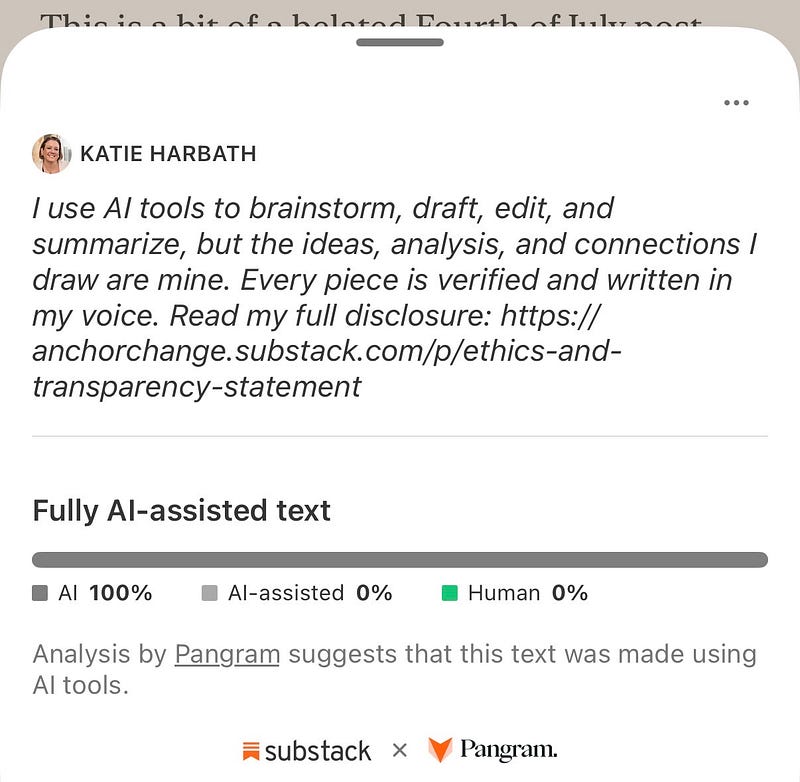
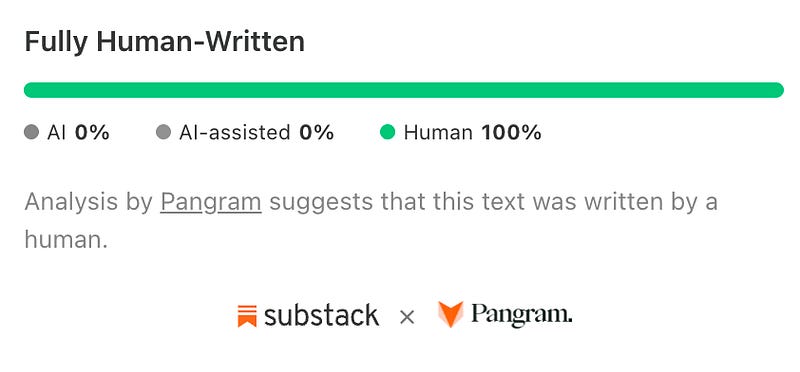
Earlier this week, we announced a feature that allows readers to scan text published to Substack to see how much of it is estimated to be written by hand or with AI assistance. We also launched tools for publishers, including the ability to run the program—Pangram—on drafts prior to publication, disable scanning on a post-by-post basis, and add a “How I make this” statement explaining their creative process to set expectations for their readers. These features do not use publisher content, either through Substack or Pangram, to train generative AI models and are now available on web, iOS, and Android.
Norms around AI use and its disclosure are unsettled. But we have made the assessment that while the use of AI isn’t necessarily a problem, a lack of transparency around it definitely is. Our aim is to help writers get credit for the work that’s theirs and help their audiences make more informed choices about what they spend their time on.
Substack has long been home to brilliant writers and thinkers exploring questions about AI disclosure, making a livelihood through writing, and whether technology can replace human effort in art.
Archie Hall, a columnist at The Economist, is highly bullish on AI’s economic upside but recoiled from AI-written prose: “We should shun AI writing even if it is perfectly bearable to read,” he wrote. Science fiction writer Lincoln Michel evangelized intention, and said that AI output can’t be art because it isn’t the product of choices. The Hinternet Editorial Board proposed a Mohs-style scale of AI reliance, from 0 to 10, and Sam Kriss menaced, “If you let AI do your writing, I will come to your house and kill you.”
Writers have methodically tested what AI can and can’t generate. Freddie deBoer ran an experiment to track if an LLM could write the parts of a novel that aren’t the prose itself. Engineer, founder, and former venture capitalist Rohit Krishnan tried to measure the statistical signature of literary style, interested to see if a model could eventually learn to write with it. Literature professor Hollis Robbins examined two very different approaches to LLM-generated poetry and asked whether either gets anywhere close to greatness: “For poets, edge cases are the poem.” Elle Griffin wrote a fictional day-in-the-life in a future AI utopia, and Andrea Bartz, the named plaintiff in Bartz v. Anthropic, the case that resulted in a $1.5 billion settlement for writers, wrote her own detailed argument against generative AI today.
Writer Teddy (T.M.) Brown named an economic reality rather than a spiritual one—that most commercial writing was never really creative expression to begin with, so what’s disappearing is a livelihood, not a soul: “I am less threatened by the presence of bad writing created by robot-equipped dullards than I am by the specter of there being no way to make a living as a writer at all.”
The common thread? We believe that human perspective is an essential ingredient of culture, and this will be true no matter how powerful AI becomes.
In the days since the AI scan feature was announced, we’ve seen many publishers putting the tools to use, and initial responses suggest that transparency is the right first step toward protecting writers and improving the experience for their readers.
 |
|




 |
|
|

 |
|
|

 |
|
Others have raised nuanced concerns about the limitations of labeling and potential downsides for the culture of the community on Substack: the risk of false flags, the limits of what a label can actually capture about a piece of writing, and the potential instinct to scrutinize one another’s process rather than engage with the work itself.
 |
|
 |
|
AI tool user Monica Hebert wrote a post expressing her concerns about the AI scan, calling it a moral purity test in disguise:
A detection tool might estimate whether AI was involved in producing a piece of text. What it cannot tell you is who had the original thought. Who lived the experience. Who spoke the story aloud, rejected the first version, changed the argument, removed the bad language, restored the humor, moved the paragraphs, rewrote the ending, and edited the entire thing again on the Substack page. It cannot tell you who supplied the life. Seventy years old, and using AI.
We read all of your feedback, which we take seriously as we continue to evolve the product and host open conversation on this topic. Based on your comments, we made a change yesterday so that publishers can disable scanning on a post-by-post basis without having to scan the post first or interact with Pangram at all.
We also know that the use of AI tools is incredibly nuanced, with as many use cases as there are creators on the platform. You can create a “How I make this” statement, visible whenever someone scans a piece of your writing. Many publishers have already drafted their own statements, sharing their views on AI and explaining to their readers how, and whether, they use these tools:
“In my writing, the first draft is always mine. I use AI in editing, mostly for clarity. In preparing to write, I often test my ideas against AI and use it to gather background material, including some data analysis and charting that I direct. Any errors or omissions are mine.”
“English is not my first language. I use AI as an editor to help me express my thinking in clear, professional English — the way a native-speaking writer would work with a copy editor. It shapes the prose, never the substance.”
“No AI to see here darlings!”
“I use AI throughout my writing process: research, drafting, writing, editing. I typically start with 10-15 min of voice to transcript to capture my thoughts in their raw form, to ensure they are mine. Then I work with a model to draft and iterate until the writing accurately represents my thinking and intent. So, TL;DR if a scan flags this as AI-assisted, that’s accurate and expected.”
—Nate
“I write gatekept using an open google doc, caffeinated beverages that no longer have any effect on me, and a prayer”
“Welcome to The Female Edge. I want to be transparent about how this post was written: every idea here is mine, drawn from my own research, my clinical practice for 30 years, and my six published books. I use AI tools trained on my own writing to help me edit and publish more efficiently, the same way I’d use any other tool in my practice. The framework, models, critical thinking, clinical recommendations, and the care behind it are entirely my own. Thank you for being here.”
“I use Claude like an editor uses a team of reporters, which is what I did for most of my career: send them out to gather stories, guide them in how to write those stories up, challenge them on their sources, thoroughly edit their drafts, write their headlines and standfirsts, hit the publish button, and then face the critics (and lawyers) the next day.”
“This involved a lot of hard, human work. Not AI.”
We’re invested in continuing the conversation. Our aim is to help build trust between you and your readers and create an environment that allows you to make the choices that are right for your creative work and your business. Starting next week, we’ll be kicking off a new series, Model Behavior, featuring top writers, creators, and thinkers addressing this conversation and exploring how they work in the age of AI.
And we’d like to continue to hear from all of you: restack, comment, share your “How I make this” statement, or tell us how you think Substack can best support writers and creators as they navigate the muddy waters of AI.
Thanks for subscribing to On Substack. This post is public, so feel free to share it.
| ||||||||||
| ||||||||||